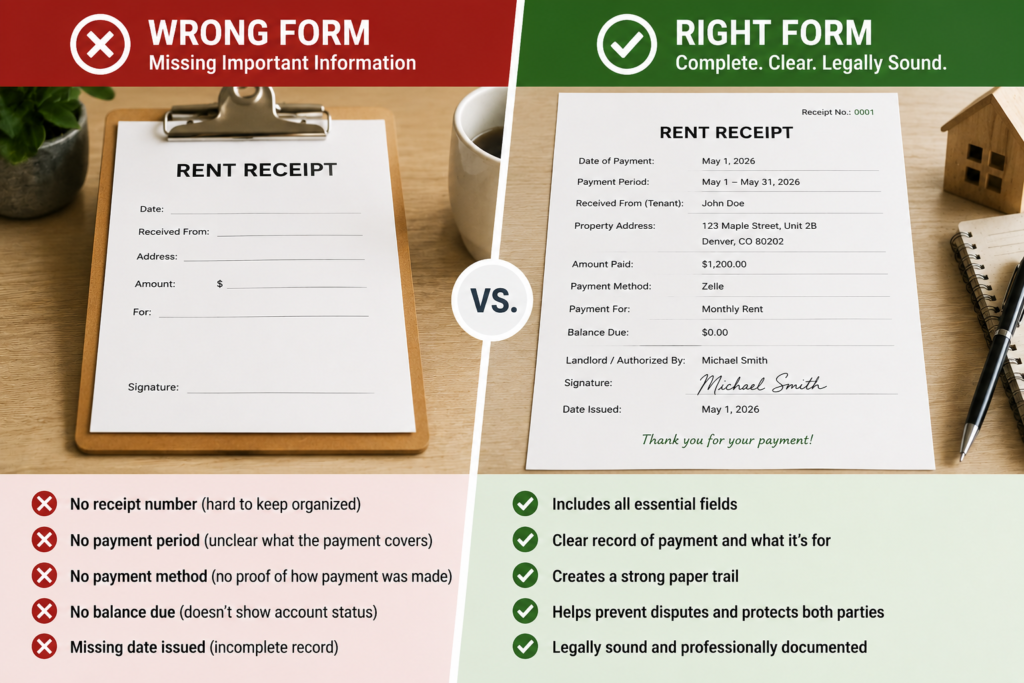
A rent receipt form is just a structured way to document a rent payment. Nothing fancy. But a surprising number of landlords either skip it entirely, use a form that’s missing critical fields, or download a template that’s overcomplicated for what they actually need.
The result is the same in every case: when a dispute comes up — a missed payment claim, a security deposit argument, a small claims filing — the documentation isn’t there.
This post shows you exactly what a rent receipt form needs to include to be useful, what’s optional, what common mistakes to avoid, and how to generate your free rent receipt at FreeRentReceipt.com instead of hunting for a template that may or may not have all the right fields.
What Is a Rent Receipt Form?
A rent receipt form is a pre-structured document — printed or digital — that contains labeled fields for all the information a rent receipt needs to capture. The “form” part just means the fields are already laid out; you fill them in for each payment.
It’s the same as a rent receipt in terms of legal purpose and content. The word “form” typically refers to the blank template version — before it’s filled in. Once completed and signed, it becomes a rent receipt.
You’ll encounter rent receipt forms in a few formats:
- Paper forms in a receipt book (carbonless NCR paper, filled out by hand)
- Fillable PDF templates you download and complete digitally
- Word or Google Docs templates you maintain and update each month
- Online generators that produce a completed PDF from fields you fill in on a web form
Each format produces the same end result — a completed, signed receipt — but with different tradeoffs in speed, storage, and convenience.
The Fields Every Rent Receipt Form Must Have
Not all rent receipt forms are created equal. Some downloadable templates online are missing fields that matter. Here’s what every form needs to include to be legally sound and practically useful.
1. Receipt Number
A sequential number that identifies this receipt in your records. Formatted as four digits — 0001, 0002, 0003 — so they sort correctly in a file system or folder. This field creates a numbered audit trail: if receipt 0027 is missing, that gap is itself documentation.
Don’t skip this field just because it feels bureaucratic. It becomes important fast when you’re managing multiple units across multiple years.
2. Date of Payment
The actual date the payment was received — not the due date, not the date you processed it. If rent was due on the 1st and received on the 4th, the receipt says the 4th. Accuracy here is what makes the receipt reliable as a record.
3. Payment Period
The date range the payment covers. For standard monthly rent: “July 1 – July 31, 2025.” For pro-rated first months, partial periods, or unusual arrangements, list the exact start and end dates. This field answers the question that matters most in a dispute: what was this payment actually for?
4. Tenant’s Full Legal Name
The name on the lease — not a nickname, not a first name only. If two people are co-tenants and both are on the lease, list the name of whoever made this specific payment, or both names if it’s a joint payment. Matching the name on the receipt to the name on the lease makes the paper trail coherent.
5. Property Address
Full street address including unit number. If you own multiple rental properties, this field is what ties the receipt to the right one. A receipt without an address is a receipt for nothing in particular.
6. Amount Paid
The exact dollar amount received — down to the cent. If a tenant paid $850 of a $1,200 balance, write $850.00. Never write the full rent amount when only a partial payment was received. That’s a documentation error that creates confusion later and may have legal implications in eviction proceedings.
7. Payment Method
How the money arrived: cash, personal check (include the check number), money order, Zelle, Venmo, ACH bank transfer, cashier’s check. Be specific. “Electronic payment” is too vague. For cash especially, this field is the only corroborating detail you have beyond the receipt itself.
8. What the Payment Is For
“Monthly Rent” is the most common entry, but also document: partial rent, late fee, security deposit, pet deposit, first and last month’s rent. If a payment covers more than one item, break it out. Don’t let a late fee get buried under “Monthly Rent” — keep the records clean.
9. Balance Due
The amount still owed after this payment is applied. If paid in full: $0.00. If not: the exact remaining balance. This is one of the most important fields on the form because it documents the state of the account at the time of the receipt — not just that a payment was made.
10. Landlord Name and Signature
Your full name and your signature. The signature is what converts the form from a filled-in document to an authenticated receipt. Without it, a tenant has no way to prove the landlord acknowledged the payment. If you manage through an LLC or property management company, sign as the authorized agent and note the entity.
11. Date Issued
Usually the same as the date of payment — but not always. If a tenant slides cash under your door on a Friday night and you don’t process it until Monday, the issue date might differ. Keeping both dates accurate prevents confusion in a paper trail.
Optional Fields Worth Considering
The ten fields above are the core. These additional fields aren’t required but can add useful context in certain situations:
Unit number (separate field) — Useful if your form is shared across multiple properties and you want the unit isolated from the street address.
Lease term or lease type — “Month-to-month” or “12-month lease ending December 2025.” Adds context for anyone reviewing the receipt later.
Notes / Remarks — A freeform line for anything that doesn’t fit neatly elsewhere. Examples: “Tenant paid via two separate money orders,” “Late fee waived per verbal agreement,” “Partial payment accepted pending hardship review.” Don’t overuse this field — but having it available is useful.
Next payment due date — Some landlords include this as a courtesy reminder. Not a required field, but it reduces “when is rent due?” questions.
What to Leave Off a Rent Receipt Form
Just as important as what to include is what doesn’t belong:
Social Security numbers or tax ID numbers — Never include sensitive identifying information on a rent receipt. This document changes hands and could be left somewhere accessible.
Bank account numbers — Same reason. Don’t include your banking details or the tenant’s on a receipt.
Legal language and clauses — A receipt is a receipt, not a lease amendment. If you need to communicate something legal, do it in writing separately. Cluttering a receipt with terms and conditions makes it harder to read and doesn’t add legal standing.
Future rent amounts or rate changes — A receipt documents what was paid, not what will be owed. Keep it to the current transaction.
Common Mistakes on Rent Receipt Forms
Leaving the Payment Method Blank
Especially for cash payments. Without the payment method documented, the receipt doesn’t tell you how the money arrived — which is often the critical question in a dispute.
Writing the Full Rent Amount When Only Part Was Paid
If your tenant paid $700 of $1,200 and you write $1,200 on the receipt, you’ve created a false record — even if unintentionally. Always write exactly what was received.
Skipping the Signature
An unsigned form is just a printed document. The landlord’s signature is what makes it a receipt. Develop the habit of signing every receipt before handing it over or emailing the PDF.
Not Keeping a Copy
Every receipt you issue should have a corresponding copy in your records. Digital PDFs make this easy — save to a folder organized by tenant and year. For landlords still using paper receipt books, photograph each completed receipt before tearing it out. For a practical system that holds up at tax time, see our post on how to organize rental income records for tax season.
Using a Form That’s Missing Fields
A lot of generic receipt templates online — designed for retail or services — don’t have a payment period field, a balance due field, or a property address line. Those gaps matter in a landlord-tenant context. Always use a form designed specifically for rent receipts.
Fillable Rent Receipt Form vs. Online Generator
If you search for a “fillable rent receipt template,” you’ll find a range of options — PDF downloads, Word files, Google Docs templates. They work, but they come with maintenance overhead: you have to update fields manually, manage file versions, and make sure you’re not accidentally reusing an old receipt with the wrong details.
An online generator eliminates all of that. The fields are already structured correctly, the form resets for every new receipt, and the output is a clean PDF ready to email or print. There’s nothing to download, no template to manage, and no risk of sending a receipt with last month’s dates still in it.
Generate your free rent receipt at FreeRentReceipt.com — all the right fields, none of the template management, takes under 60 seconds.
For a look at how receipts fit into the broader documentation picture — including how they differ from a lease — see our post on rent receipt vs. lease agreement — what’s the difference.
Are There Legal Requirements for What a Rent Receipt Form Must Include?
Requirements vary by state. Many states specify that a rent receipt for a cash payment must include at minimum: the amount paid, the date, the property address, and the landlord’s signature. Some states require additional fields. A few have no formal specification but courts still expect complete documentation.
For state-specific requirements, see our state-by-state rent receipt laws guide, which covers what each state mandates. You can also check HUD.gov’s rental assistance and tenant protection resources for federal housing guidance, or review Nolo’s landlord-tenant law library for plain-English summaries by state.
The IRS expects landlords to maintain accurate rental income records — including documentation of individual payments. IRS Publication 527 covers recordkeeping requirements for residential rental property.
Disclaimer: This post is for informational purposes only and does not constitute legal advice. Landlord-tenant laws vary by state. Consult a licensed attorney or your state’s housing agency for guidance specific to your situation.
Frequently Asked Questions
What is a rent receipt form?
A rent receipt form is a structured template — blank or partially pre-filled — containing labeled fields for all the information a rent receipt needs to capture. Once completed and signed for a specific payment, it becomes a rent receipt. It’s available as a paper booklet, a downloadable PDF, a Word or Google Docs template, or through a free online generator like FreeRentReceipt.com.
Is a blank rent receipt form the same as a fillable rent receipt template?
Essentially, yes. A blank rent receipt form and a fillable rent receipt template both refer to the unfilled version of a rent receipt — a structured document with labeled fields waiting to be completed. The terminology varies but the purpose is identical.
Does a rent receipt form need to be notarized?
No. A rent receipt does not need to be notarized in any U.S. state. It needs to be signed by the landlord — that’s it. Notarization is reserved for more formal legal documents like deeds and powers of attorney. A signed receipt is sufficient.
Can I use one rent receipt form for multiple tenants?
You can use the same form template for multiple tenants — that’s the point of a template. But each completed receipt should be specific to a single tenant, a single payment, and a single rental period. Never combine two tenants’ payments on one receipt, even if they share a unit.
Where can I get a free rent receipt form?
The fastest option is FreeRentReceipt.com — an online generator with all the right fields built in. You fill in the details, download the PDF, and send it to your tenant in under 60 seconds. No account required, no template to manage. You can also find downloadable templates on legal resource sites, but make sure any template you use includes all ten required fields before you rely on it.
Skip the template search. Generate your free rent receipt at FreeRentReceipt.com — every field, every time, ready in under 60 seconds.
