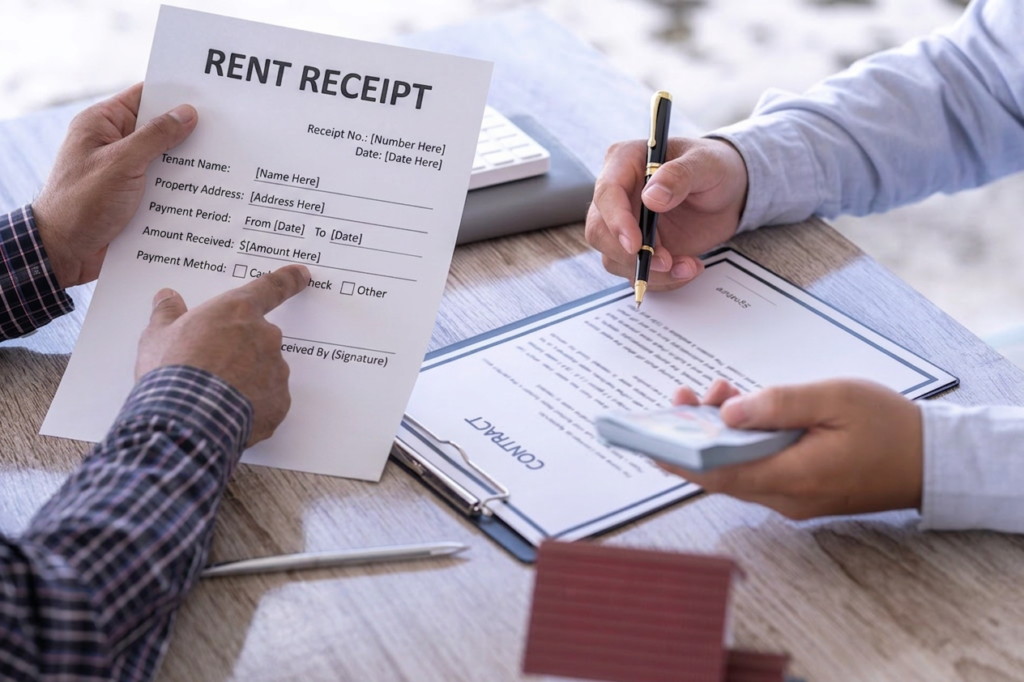
If you’ve never issued a rent receipt before, the hardest part isn’t the writing — it’s knowing what a correct one actually looks like. Search for a “rent receipt example” and you’ll find plenty of blank templates, but very few that show you a receipt filled out the right way, field by field.
This post fixes that. Below you’ll find three complete rent receipt examples — a standard monthly payment, a cash payment, and a partial payment — each annotated so you can see exactly what goes where and why. Whether you’re a landlord issuing your first receipt or a tenant who wants to know what to expect from yours, you’ll leave knowing what “done correctly” looks like.
Want a receipt that looks exactly like these examples? Generate yours free at FreeRentReceipt.com in under 60 seconds.
This article is for informational purposes only and does not constitute legal or tax advice. Laws vary by state. Consult a qualified attorney or tax professional for advice specific to your situation.
What Does a Rent Receipt Look Like?
A rent receipt is a short, one-page document that confirms a tenant paid rent. A properly filled-out rent receipt example shows the date of payment, the tenant’s name, the rental property address, the amount paid, the payment method, the rental period the payment covers, and the landlord’s name and signature. It can be handwritten, typed, or generated online — what matters is that every field is complete and legible.
That’s the short answer. But “complete and legible” looks slightly different depending on how the rent was paid. A cash receipt needs to call out the payment method explicitly. A partial payment receipt needs to show the balance still owed. A standard monthly receipt needs a clearly stated rental period. The three examples below cover each scenario. (If you want a refresher on the document itself before diving into examples, start with what is a rent receipt and how it differs from a lease.)
Rent Receipt Example — Standard Monthly Payment
This is the most common scenario: a tenant pays the full month’s rent by check or electronic transfer, and the landlord issues a receipt. Here’s what a correctly completed version looks like:
RENT RECEIPT — No. 0147
Date: June 1, 2026 Received From: Maria Delgado Property Address: 412 Palmetto Ave, Unit 2, Tampa, FL 33603 Amount Paid: $1,450.00 Payment Method: Check (No. 2208) Rental Period: June 1 – June 30, 2026 Received By: James Okafor (Landlord) Signature: James Okafor
What makes this example correct: the rental period is spelled out with start and end dates, not just “June rent.” The check number is recorded next to the payment method, which ties the receipt to the tenant’s own bank records. And the receipt number (No. 0147) keeps the landlord’s records sequential — a small habit that pays off at tax time.
Rent Receipt Example — Cash Payment
Cash is where receipts stop being optional and start being essential. There’s no bank record, no canceled check, no payment app history — the rent receipt example is the only proof the payment happened. Some states actually require landlords to issue receipts for cash rent; Washington, for example, mandates it under RCW 59.18.063. Here’s a correctly filled-out cash example:
RENT RECEIPT — No. 0148
Date: June 3, 2026 Received From: Devon Brooks Property Address: 88 Linden St, Apt B, Newark, NJ 07105 Amount Paid: $1,200.00 Payment Method: CASH Rental Period: June 1 – June 30, 2026 Received By: Anita Reyes (Landlord) Signature: Anita Reyes Tenant Copy Provided: Yes
Two details matter most here. First, the payment method is written prominently — “CASH,” not left blank or assumed. Second, the tenant gets a copy on the spot, and the landlord keeps a duplicate. With no electronic trail, both parties need their own record. For a deeper look at documenting cash rent the right way, see our guide to the cash rent receipt.
Rent Receipt Example — Partial Payment
Sometimes a tenant can only pay part of the rent and brings the rest later. A standard receipt won’t cut it here — it could be read as confirming full payment. A partial payment receipt adds two fields: the amount still owed and the date it’s due.
RENT RECEIPT — PARTIAL PAYMENT — No. 0149
Date: June 5, 2026 Received From: Sam Whitfield Property Address: 1916 Oak Hollow Dr, Austin, TX 78745 Amount Paid: $800.00 Payment Method: Zelle Rental Period: June 1 – June 30, 2026 Total Rent Due: $1,600.00 Balance Remaining: $800.00 — due June 15, 2026 Received By: Priya Nair (Landlord) Signature: Priya Nair
The “Balance Remaining” line is what makes this receipt work. It confirms the $800 was received while making clear — in writing, signed by both the landlord’s hand and the tenant’s records — that the month isn’t paid in full. Without it, a partial receipt can create exactly the dispute it was supposed to prevent.
What Every Field on a Rent Receipt Example Means
Each example above uses the same core fields. Here’s what goes in each one and why it matters:
- Receipt number: A sequential ID (0147, 0148, 0149…) that keeps your records organized and makes individual payments easy to find later.
- Date: The date the payment was received — not the date rent was due. These aren’t always the same, and the difference matters in late-payment disputes.
- Received from (tenant name): The full legal name of the person who paid. If a roommate or family member paid on the tenant’s behalf, note that too.
- Property address: The full rental address, including the unit number. Landlords with multiple units need this to keep records straight per property.
- Amount paid: The exact dollar figure received, written clearly. No rounding, no abbreviations.
- Payment method: Cash, check (with check number), money order, or app (Zelle, Venmo, etc.). This field connects the receipt to any external payment record — or stands in for one when cash is involved.
- Rental period: The specific dates the payment covers (e.g., June 1–30, 2026). This is the most commonly skipped field and the one that prevents the most disputes.
- Landlord name and signature: The person who received the payment, signed. The signature is what turns a slip of paper into proof.
If you’d like a step-by-step walkthrough of completing each field, we cover it in detail in how to fill out a rent receipt.
Stop filling out receipts by hand — generate your free rent receipt at FreeRentReceipt.com with every field pre-formatted, professional, and ready to download instantly.
Common Mistakes on Rent Receipts (And How to Avoid Them)
Even with a good example to follow, the same handful of errors show up again and again:
Leaving out the rental period. A receipt that says “$1,450 received” without dates doesn’t prove which month was paid. Always write the start and end dates of the period covered.
Skipping the payment method on cash receipts. If the method field is blank, the receipt loses half its value. Write “CASH” explicitly — it signals there’s no other record and this document is the proof.
Issuing a standard receipt for a partial payment. A normal receipt implies the rent is settled. Use a partial payment format with a clear balance-due line whenever less than the full amount changes hands.
Illegible handwriting. A receipt nobody can read is a receipt that won’t hold up. If your handwriting is questionable, type it or generate it digitally.
Not keeping a copy. The tenant’s copy protects the tenant; your copy protects you. Duplicate every receipt — landlords need this payment trail for their own records and at tax time, as Nolo’s recordkeeping guide for landlords explains.
Reusing or skipping receipt numbers. Out-of-sequence numbering makes your records look sloppy at best and suspicious at worst. Number sequentially and never reuse.
Generate a Professional Rent Receipt Instantly
You could copy the examples above by hand every month — or you could let a tool do the formatting for you. The free rent receipt generator at FreeRentReceipt.com produces receipts that look exactly like the examples in this post: every field included, cleanly formatted, downloadable as a PDF in seconds. No account, no install, nothing to buy.
It handles every scenario shown here — monthly, cash, and partial payments — and because the fields are pre-built, you can’t accidentally skip the rental period or forget the payment method. If you’re not sure whether your state has specific receipt requirements, check the rent receipt laws by state overview before you issue your first one.
One note on related posts: if you only need to see one complete sample walked through line by line, our companion post on a rent receipt example filled out does exactly that. This post goes wider — multiple scenarios — while that one goes deep on a single sample.
For more rental management advice, browse our Landlord Tips category. For receipt templates, documentation help, and proof-of-payment guidance, explore our Rent Receipts category.
Every example in this post was generated at FreeRentReceipt.com — free, professional, and ready to download in seconds. Generate your own and your next receipt will look exactly like the ones above.
FAQs: Rent Receipt Examples
What does a rent receipt look like?
A rent receipt is a one-page document showing the payment date, tenant name, property address, amount paid, payment method, rental period covered, and the landlord’s name and signature. It can be handwritten, typed, or digitally generated — see the three filled-out examples above for what each version looks like.
What should be included in a rent receipt example?
Every complete rent receipt example includes eight core fields: receipt number, date received, tenant name, property address, amount paid, payment method, rental period, and landlord signature. Cash receipts should mark the method prominently, and partial payment receipts should add a balance-due line.
Can a rent receipt be handwritten?
Yes. A handwritten rent receipt is just as valid as a typed or generated one, as long as every field is filled in and the writing is legible. The risk with handwritten receipts is human error — skipped fields, unclear amounts, or unreadable signatures — which is why many landlords switch to a generator.
What is an example of a partial rent payment receipt?
A partial rent payment receipt looks like a standard receipt with two extra fields: the total rent due and the balance remaining, including the date the remainder is due. See the partial payment example above — the “Balance Remaining: $800.00 — due June 15, 2026” line is what distinguishes it.
Is a rent receipt the same as a rent invoice?
No. An invoice is issued before payment and requests money owed; a receipt is issued after payment and confirms money received. The invoice says “you owe $1,450 by June 1,” while the receipt says “I received $1,450 on June 1.”
How do I know if my rent receipt is filled out correctly?
Check it against the eight core fields: number, date, tenant name, property address, amount, payment method, rental period, and signature. If any field is blank — especially the rental period or payment method — the receipt is incomplete. Comparing yours to the examples in this post is the fastest gut check.
