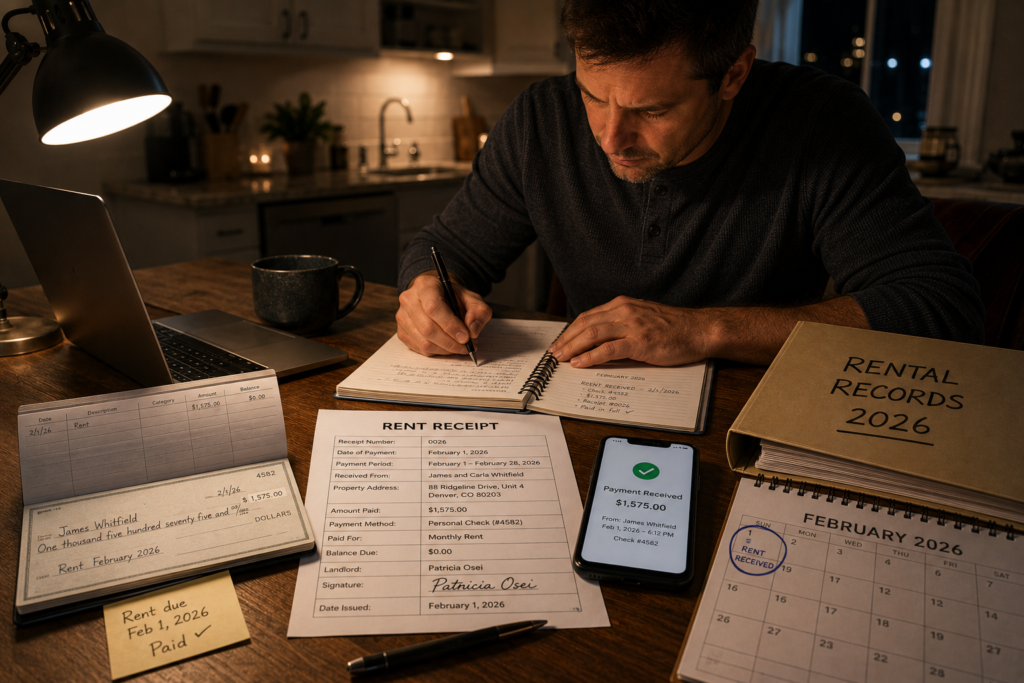
Most landlords don’t think about rent receipts until something goes wrong. A tenant says they paid. You say you didn’t receive it. Or you need to show proof of consistent rental income for a refinance and realize your records are a mess of Venmo screenshots and sticky notes.
A proper receipt for rent payment solves both problems before they happen. It creates a clean, dated, signed record of every transaction — one that holds up if a dispute goes to court, a housing authority, or just an awkward conversation at the door.
This post shows you exactly what a rent payment receipt should include, walks through a real sample scenario, and explains how to generate your free rent receipt at FreeRentReceipt.com in under 60 seconds.
What Is a Receipt for Rent Payment?
A receipt for rent payment is a written document that confirms a landlord received money from a tenant for rent. It records the specifics of the transaction — who paid, how much, for what property, covering which time period, and in what form the payment arrived.
It is not the same as a lease agreement. A lease defines the terms of the rental relationship. A receipt documents that a specific payment was made under those terms. The two work together — but they serve different purposes. If you want a deeper look at how they differ, see our post on rent receipt vs. lease agreement — what’s the difference.
Who Needs a Receipt for Rent Payment?
Both parties benefit — but for different reasons.
Tenants need receipts as proof they paid. This matters when:
- A landlord incorrectly claims a payment was missed
- They’re applying for rental assistance and need to document housing costs
- They’re disputing a security deposit deduction that claims unpaid rent
- They need proof of residence for government programs or benefits
Landlords need receipts as proof they received payment. This matters when:
- A tenant disputes a late fee or eviction notice
- They need to show rental income history for a loan or refinance
- They’re preparing for tax season and need clean records
- A dispute ends up in small claims court
The IRS also expects landlords to keep accurate records of rental income. IRS Publication 527 covers recordkeeping requirements for residential rental property — and individual receipts are the foundation of that system.
What a Receipt for Rent Payment Must Include
Every rent payment receipt should have these fields filled in completely:
1. Receipt Number A sequential number assigned to each receipt. This creates a trackable record — if receipt #0031 is missing from your files, that gap is meaningful.
2. Date of Payment The date the payment was actually received — not the due date. If rent is due on the 1st but paid on the 4th, the receipt should say the 4th.
3. Payment Period The time frame the payment covers. Typically the first to the last day of the month for standard monthly rent. For partial payments or unusual arrangements, be specific about the dates.
4. Tenant’s Full Name The legal name of the person making the payment, exactly as it appears on the lease. Avoid nicknames.
5. Property Address Full address including unit number. Essential if you manage more than one property.
6. Amount Paid The exact dollar amount received. If the tenant paid $900 of a $1,200 balance, write $900 — not $1,200.
7. Payment Method Cash, check, money order, Zelle, Venmo, bank transfer, cashier’s check. Be specific. Payment method is especially important for cash transactions where no bank record exists.
8. What the Payment Is For “Monthly Rent” is the most common, but also document: partial rent, late fees, security deposit, pet deposit, or first/last month’s rent. Accurate labeling prevents disputes about what the money was actually for.
9. Balance Due The remaining amount owed after this payment. Zero if paid in full. If there’s still a balance, write the exact number.
10. Landlord Name and Signature Your name and signature authenticate the receipt. An unsigned receipt is just a note. If you manage through an LLC, sign as the authorized agent.
Sample Receipt for Rent Payment — Two Real Scenarios
Scenario 1: Full Monthly Payment, Check
This is the most common situation — a tenant pays the full month’s rent by check on or near the due date.
RENT RECEIPT
| Field | Entry |
|---|---|
| Receipt Number | 0022 |
| Date of Payment | April 1, 2025 |
| Payment Period | April 1 – April 30, 2025 |
| Received From | James and Carla Whitfield |
| Property Address | 88 Ridgeline Drive, Unit 4, Denver, CO 80203 |
| Amount Paid | $1,575.00 |
| Payment Method | Personal Check (#4471) |
| Paid For | Monthly Rent |
| Balance Due | $0.00 |
| Landlord | Patricia Osei |
| Signature | (signed) |
| Date Issued | April 1, 2025 |
Notes on this receipt: Both tenants are named since both are on the lease. The check number is included in the payment method field — useful if the check ever bounces. Balance due is $0.00 confirming payment in full.
Scenario 2: Partial Payment, Cash, Month-to-Month Lease
This scenario is trickier — a tenant on a month-to-month arrangement pays part of the rent in cash, with a remaining balance.
RENT RECEIPT
| Field | Entry |
|---|---|
| Receipt Number | 0023 |
| Date of Payment | April 5, 2025 |
| Payment Period | April 1 – April 30, 2025 |
| Received From | Devon Castillo |
| Property Address | 412 Maple Street, Apt 2B, Miami, FL 33196 |
| Amount Paid | $800.00 |
| Payment Method | Cash |
| Paid For | Partial Monthly Rent |
| Balance Due | $400.00 |
| Landlord | Sandra Perez |
| Signature | (signed) |
| Date Issued | April 5, 2025 |
Notes on this receipt: Payment is four days late — the receipt reflects the actual date received, not the due date. “Paid For” is labeled “Partial Monthly Rent” — not just “Monthly Rent” — so there’s no ambiguity about what was received. The $400 balance due is documented clearly, creating a paper trail for follow-up.
Accepting a partial payment from a tenant can have legal implications depending on your state — particularly around eviction proceedings. Check your state’s landlord-tenant statutes or review HUD.gov’s rental assistance and tenant protection resources before accepting partial payments if an eviction is already in progress.
Month-to-Month Leases and Receipts
Month-to-month rental arrangements deserve extra attention when it comes to receipts. Because there’s no fixed lease end date and the arrangement can change with relatively short notice, having clean payment records is more important — not less.
If a landlord wants to end a month-to-month tenancy and a tenant disputes back-owed rent, the receipt record is what determines who’s right. A complete, sequential set of receipts showing every payment received (and when) is your best protection.
For a deeper look at what landlords are legally required to document, our post on state-by-state rent receipt laws covers which states mandate written receipts and what they must include.
How to Get a Receipt for Rent Payment Fast
You have three options:
1. Paper receipt book — Available at office supply stores for $6–$15. Uses carbonless copy paper so both parties get a copy. Works fine for cash payments but can’t be emailed, fades over time, and has no digital backup.
2. Word or Google Docs template — You can build your own template and fill it in each month. More flexible than a receipt book, but requires you to manually track numbering, save copies, and maintain the file yourself.
3. Free online generator — The fastest option. Fill in the fields, download a clean PDF, email it to your tenant. Takes under 60 seconds, produces a professional document, and costs nothing.
Generate your free rent receipt at FreeRentReceipt.com — no account required, works on your phone or computer.
Disclaimer: This post is for informational purposes only and does not constitute legal advice. Landlord-tenant laws vary by state. Requirements around rent receipts — including when they’re mandatory and what they must contain — differ by jurisdiction. Consult a licensed attorney or your state’s housing agency for guidance specific to your situation.
Frequently Asked Questions
Is a landlord required to give a receipt for rent payment?
It depends on your state and the payment method. Many states require landlords to provide a written receipt specifically for cash payments. Some states require receipts for all payment types. Others have no explicit requirement but courts still expect documentation in disputes. See our state-by-state rent receipt laws guide for specifics, or check Nolo’s landlord-tenant law library for plain-English state summaries.
What should a receipt for rent payment include?
At minimum: the date of payment, tenant’s full name, property address, amount paid, payment method, the period covered, what the payment is for, any remaining balance, and the landlord’s name and signature. Some states may require additional fields.
Can a text message or email confirmation count as a receipt?
In some cases, yes — courts have accepted electronic communications as evidence of payment. But a formatted receipt with all required fields is far more defensible than a Venmo notification or a “got it, thanks” text. If you’re collecting rent digitally, pair each payment with a proper receipt.
What is the difference between a rent receipt and a rent statement?
A rent receipt documents a single payment transaction. A rent statement is a running ledger showing all payments, charges, and balances over a period of time. For most small landlords managing one to four units, individual receipts are sufficient. Rent statements become more useful in larger-scale management or when a tenant needs a full payment history for a housing application.
How long should I keep receipts for rent payments?
Keep rent receipts for at least three to five years after a tenancy ends. This covers the typical statute of limitations for small claims court in most states, as well as IRS audit windows for rental income. Digital PDFs stored in a cloud folder are easier to maintain long-term than paper records.
Whether it’s a full payment or a partial one, every transaction deserves a proper record. Generate your free rent receipt at FreeRentReceipt.com — free, instant, no account needed.
