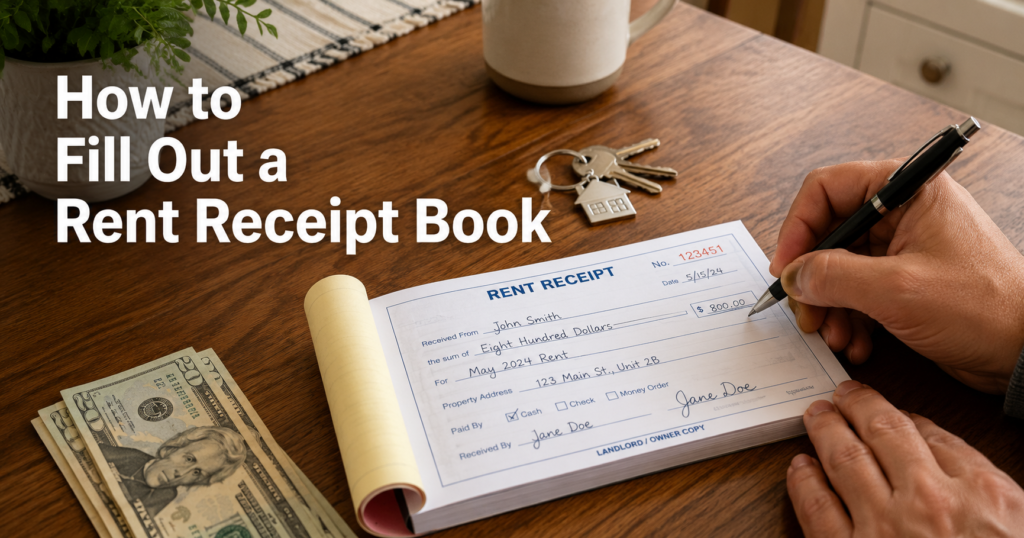
If you bought a rent receipt book from the office supply store and now you’re how to fill out a rent receipt book staring at all those little fields wondering what goes where — you’re not alone. These books aren’t exactly self-explanatory, and one wrong entry can create headaches if a tenant ever disputes a payment.
The good news: filling one out correctly takes less than two minutes once you know the pattern. This guide walks you through every field, every time, so your records stay clean and your tenants stay accountable.
And if you’d rather skip the paper book entirely, you can generate your free rent receipt at FreeRentReceipt.com — no book required, printable in seconds.
What’s in a Standard Rent Receipt Book?
Most rent receipt books — the kind you find at Staples, Office Depot, or Amazon — are pre-printed duplicate or triplicate pads. You write once on the top copy, and the carbon copies below automatically duplicate your entry. One copy stays in the book; you tear the other out for your tenant.
Here’s what you’ll typically find on each receipt:
- Date
- Received from (tenant name)
- Amount received
- Payment method (cash, check, money order)
- For the period (what rent dates are being paid)
- Property address
- Balance due (if any)
- Received by (your signature or initials)
- Receipt number
Some books also include a “check number” field or a “note” line. Fill in everything that applies — blank fields are missed opportunities to document the transaction.
Step-by-Step: How to Fill Out a Rent Receipt Book
Follow these steps in order every single time a tenant pays rent. Consistency protects you.
Step 1 — Write the Date First
Always use the date the payment was actually received, not the date it was due. If rent is due on the 1st but your tenant pays on the 3rd, write the 3rd. This matters for tracking late payments.
Format: MM/DD/YYYY. Example: 05/03/2025
Step 2 — Fill In the Tenant’s Full Name
Write the tenant’s full legal name as it appears on the lease. If the lease has two tenants, include both names. Don’t write nicknames — “Mike” instead of “Michael Johnson” can create ambiguity if there’s ever a legal dispute.
Step 3 — Enter the Payment Amount
Write the dollar amount numerically in the amount box, like $1,200.00. If your book has a written-out line (like a check does), fill that in too: “One thousand two hundred dollars and 00/100.” This double-entry format is standard on many receipt books and eliminates any chance of tampering.
Step 4 — Note the Payment Method
Check or write in the payment method:
- Cash — always issue a receipt for cash payments. This is the main reason rent receipt books exist.
- Check — write the check number in the designated field
- Money order — note the money order number if available
- Electronic / Zelle / Venmo — write “electronic transfer” or the platform name
For cash payments especially, never skip this step. See our guide on rent receipts vs. lease agreements to understand why documentation matters even when you have a signed lease.
Step 5 — Specify the Rental Period
This is the field most landlords skip — and it’s one of the most important. Write the exact period the payment covers.
Examples:
June 1 – June 30, 202505/01/2025 – 05/31/2025
This protects you if a tenant later claims their payment was for a different month or period.
Step 6 — Write the Property Address
Include the full address of the rental unit, especially if you manage more than one property. If the unit has an apartment number, include it: 123 Oak St, Apt 2B, Tampa, FL 33602.
Step 7 — Fill In Any Balance Due
If the tenant paid in full, write $0.00 or “PAID IN FULL.” If they short-paid, write the remaining balance. Leaving this blank looks sloppy and can cause confusion later.
Step 8 — Sign or Initial the Receipt
Sign or initial the “Received by” line. This confirms you accepted the payment. Some landlords use a stamp with their name if they issue a high volume of receipts.
Step 9 — Record the Receipt Number
Most receipt books are pre-numbered. If yours isn’t, number them yourself starting at 001. Receipt numbers make it easy to reference a specific transaction if a tenant calls to ask about a payment.
Step 10 — Tear Out the Tenant’s Copy
The top copy (usually white) goes to the tenant. The carbon copy (usually yellow or pink) stays in the book as your record. Never let a tenant take both copies.
Common Mistakes to Avoid
Skipping the rental period. It seems obvious but many landlords just write the payment amount and move on. Without a period noted, a single receipt can look ambiguous in court.
Using pencil. Always use a pen — blue or black ink. Pencil entries can be erased and altered.
Writing illegibly. Carbon copies pick up pressure, not clarity. Press firmly and write clearly.
Forgetting to issue a receipt for cash. If you ever need to prove a tenant paid (or didn’t pay), a receipt book with a missing entry for a cash payment hurts your case. Some states also legally require receipts for cash rent payments. Check your state’s rules at rentreceiptblog.com/state-by-state-rent-receipt-laws-for-landlords-2025/.
Paper Book vs. Digital Receipts: Which Is Better?
Rent receipt books work fine for cash-paying tenants and very small landlords. But they have real limitations:
| Paper Receipt Book | FreeRentReceipt.com | |
|---|---|---|
| Cost | ~$8–$15 per pad | Free |
| Copies | 2–3 carbon copies | Unlimited digital copies |
| Search/find old receipts | Manual | Instant |
| Professional look | Handwritten | Formatted, branded |
| Best for | Cash payers, in-person | All payment types |
If you ever run out of pages, a tenant needs a replacement copy, or you just want something that looks more professional — generate your free rent receipt at FreeRentReceipt.com. It takes under a minute and you can print or email it directly to your tenant.
Do Landlords Have to Give Rent Receipts?
It depends on your state. Many states require landlords to provide a written receipt any time a tenant pays rent in cash. Some states require it for all payments regardless of method. The IRS also recommends keeping thorough records of rental income — consistent receipt-keeping makes tax time much easier.
For a full breakdown by state, see our state-by-state rent receipt laws guide. For general rental income recordkeeping guidance, the IRS Publication 527 covers what landlords need to document.
How to Store and Organize Your Receipt Book Records
Once you fill out a receipt, keep the book somewhere secure and easy to find. A few tips:
- Store completed receipt books by year in a labeled folder or box
- Photograph each completed receipt with your phone and save to a cloud folder (Google Drive, Dropbox) — this gives you a digital backup if the book is lost or damaged
- For each property, keep a simple log that matches receipt numbers to tenants and months
The IRS recommends keeping rental income records for at least three years after the return filing date — some advisors suggest longer. A completed receipt book is solid documentation.
For more on keeping your records organized, see our post on how to organize rental income records for tax season.
Filling out a rent receipt book isn’t complicated — but it’s one of those things where small habits (like always noting the rental period or signing every receipt) make a big difference over time. A complete, consistent paper trail protects you if disputes come up and keeps your tax records clean.
Don’t have a book handy, or want something that looks more professional? Generate your free rent receipt at FreeRentReceipt.com right now — no signup, no cost, printable in under a minute.
Frequently Asked Questions
What information goes on a rent receipt book?
A standard rent receipt book should include: the date of payment, the tenant’s full name, the payment amount, the payment method (cash, check, money order), the rental period covered, the property address, any remaining balance, and the landlord’s signature or initials. Most pre-printed books have fields for all of these — just fill them all in every time.
Do I need to give my tenant a rent receipt if they pay by check?
It depends on your state. Some states only require written receipts for cash payments; others require them for all payment methods. Even if it’s not legally required in your state, issuing receipts for all payments — including checks — is good practice and creates a clean record for both parties. Check your state’s specific requirements at Nolo’s landlord-tenant law guides.
How do I fill out a money rent receipt book?
“Money rent receipt book” refers to the same standard receipt pad — the word “money” just indicates it’s for monetary transactions (as opposed to a work receipt). Fill it out the same way: date, tenant name, dollar amount (written clearly, both numerically and in words if your book has both lines), payment method, rental period, property address, balance due, and your signature.
What’s the difference between a single and duplicate rent receipt book?
A single receipt book gives you one copy per page — you’d need a photocopier to keep a record. A duplicate book uses carbon paper to make two copies: one for the tenant, one for your records. A triplicate makes three. For landlords, duplicate or triplicate books are strongly recommended so you automatically keep a copy without any extra steps.
Can I use a digital receipt instead of a paper book?
Yes, and in many cases it’s more practical. A digital receipt generated from a tool like FreeRentReceipt.com contains all the same information as a paper receipt and can be emailed to your tenant or printed out. It’s especially useful for landlords who collect rent electronically and want a matching paper trail without buying physical receipt books.
Legal disclaimer: This post is for informational purposes only and does not constitute legal advice. Landlord-tenant laws vary by state. Consult a licensed attorney or your state’s housing authority for guidance specific to your situation.
