If you’ve never seen a rent receipt before — or you’ve been winging it with informal notes and want to make sure you’re doing it right — this post is exactly what you need. A proper rent receipt isn’t complicated, but it does need to hit specific fields to be useful as documentation.
Below you’ll find real examples of what a completed rent receipt looks like, with every section labeled and explained. By the end, you’ll know at a glance whether any receipt you’re issuing or receiving is complete — and you’ll be able to generate your free rent receipt at FreeRentReceipt.com in under 60 seconds.
The Short Answer: What a Rent Receipt Looks Like
What does a rent receipt look like? Rent receipt looks like any other payment receipt — think of what a store gives you when you buy something. It has a header identifying the document, a set of clearly labeled fields capturing the transaction details, and a signature at the bottom authenticating it.
What separates a rent receipt from a generic receipt is that it’s specific to a rental property transaction. The fields are designed around what matters in a landlord-tenant relationship: the property address, the rental period, the payment method, and the balance remaining.
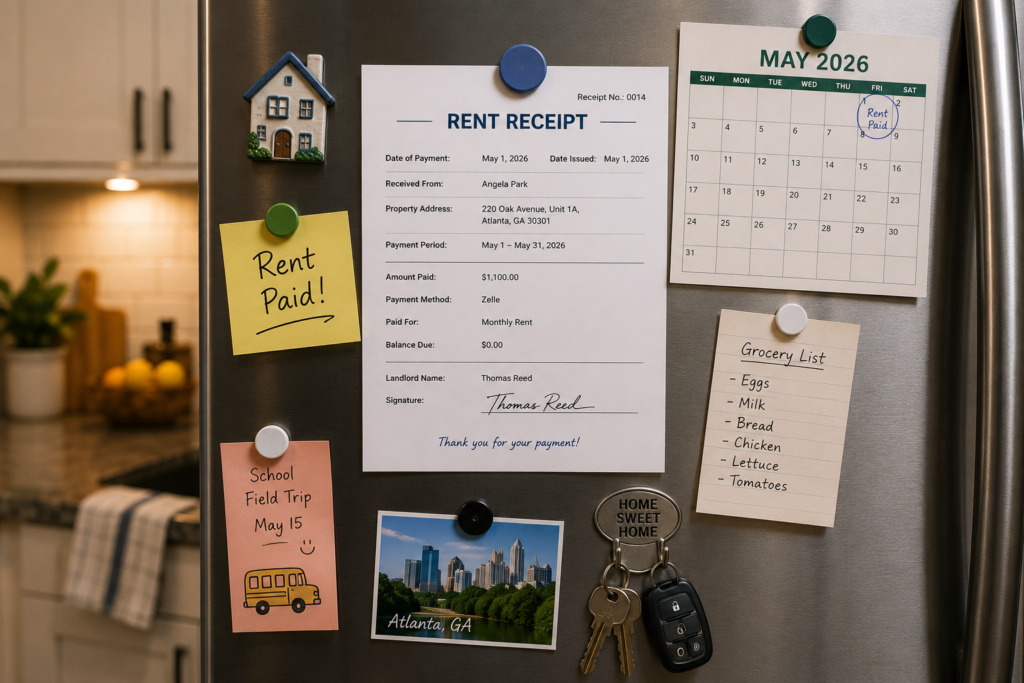
Here’s the simplest version — a basic rent receipt in plain format:
RENT RECEIPT
Receipt No.: 0014 Date of Payment: May 1, 2025
Received From: Angela Park Property Address: 220 Oak Avenue, Unit 1A, Atlanta, GA 30301 Payment Period: May 1 – May 31, 2025
Amount Paid: $1,100.00 Payment Method: Zelle Paid For: Monthly Rent Balance Due: $0.00
Landlord Name: Thomas Reed Signature: (signed) Date Issued: May 1, 2025
That’s it. Clean, complete, and easy to read. Every field has a job — and when all of them are filled in correctly, you have a document that holds up in a dispute, a housing authority review, or a tax audit.
What Each Part of a Rent Receipt Looks Like — Labeled
Let’s walk through each section so you know exactly what you’re looking at and why it’s there.
The Header: “RENT RECEIPT”
The document should be clearly labeled at the top. “Rent Receipt,” “Rental Payment Receipt,” or “Receipt for Rent Payment” all work. This label is what makes it identifiable at a glance — in a filing system, in an email attachment, or as a court exhibit.
Some landlords also include their business name or LLC name in the header if they manage properties through a legal entity.
Receipt Number
A sequential number in the top corner — usually formatted as four digits: 0001, 0002, 0014. This creates an audit trail. If receipts are numbered consecutively and one is missing, that gap is meaningful. It also makes it easy to reference a specific payment in conversation: “Can you resend receipt 0014?” is clearer than “the one from May.”
Date of Payment and Date Issued
The date of payment is when the money actually changed hands. The date issued is when you wrote and signed the receipt — usually the same day, but not always. If a tenant drops cash in your mailbox on a Friday and you don’t process it until Monday, the dates might differ. Both dates on the receipt keep the record accurate.
Received From (Tenant Name)
The tenant’s full legal name, exactly as it appears on the lease. Not a nickname, not just a first name. If two people are on the lease, name the person who made the payment — or both, if it’s a joint payment. This field ties the receipt to a specific person and a specific lease.
Property Address
The full street address, including unit number. If you own multiple rentals, this field is what connects the receipt to the right property. A receipt that just says “the apartment on Oak” is not useful documentation.
Payment Period
The date range the payment covers — for example, “May 1 – May 31, 2025.” This field answers the question: what is this money actually for? For standard monthly rent, it’s the first to the last day of the month. For partial-month situations, pro-rated first months, or unusual arrangements, the dates should reflect exactly what period is being covered.
Amount Paid
The exact dollar amount received — written out clearly, including cents. If a tenant pays $1,000 of a $1,200 balance, the amount paid is $1,000, not $1,200. Rounding up or writing the full rent amount when only part was received is a documentation error that can create real problems later.
Payment Method
This is how the money arrived: cash, check (include the check number), money order, Zelle, Venmo, bank transfer, cashier’s check. For cash payments especially, this field is critical — it’s the only evidence the transaction happened outside of this receipt itself. For digital payments, it corroborates the transfer notification.
Paid For
What the money is being applied to. Usually “Monthly Rent” — but also document: partial rent, late fees, security deposit, pet deposit, first/last month’s rent. Being specific here prevents disputes about whether a payment was for rent or for a separate charge.
Balance Due
The amount still owed after this payment. If the tenant paid in full, this reads $0.00. If there’s a remaining balance — because of a partial payment, a late fee, or another charge — write the exact number. This single field documents the current state of the account at the time of the receipt.
Landlord Name and Signature
Your name and your signature. The signature is what makes the receipt an authenticated document rather than just a note. Without it, there’s nothing proving the landlord acknowledged the payment. If you manage properties through an LLC or a management company, sign as the authorized agent and note the entity name.
What a Rent Receipt Does NOT Look Like
Just as important as knowing what’s included is knowing what’s not sufficient:
- A Venmo or Zelle screenshot — shows money moved, but doesn’t specify what it was for, which property, or which period. Not a receipt.
- A text message saying “got your rent, thanks” — informal and incomplete. Not a receipt.
- A generic invoice — an invoice requests payment; a receipt confirms it was received. Different documents, different purposes.
- A bank deposit slip — shows money entered your account, but doesn’t name the tenant or property. Not a receipt.
- A handwritten note with just a dollar amount — better than nothing, but missing too many fields to be reliable documentation.
Any of these might be accepted as supplemental evidence in a dispute, but none of them stand alone the way a properly completed receipt does.
What Different Types of Rent Receipts Look Like
Not all rent receipts look exactly the same — the format varies depending on how you generate them and what your specific situation requires.
Paper Receipt Book
A pre-printed form from an office supply store. Fields are already labeled; you fill them in by hand with a ballpoint pen. A carbonless copy stays in the book; the original goes to the tenant. Simple and tactile, but no digital backup and can’t be emailed.
Word or Google Docs Template
A formatted document you create once and reuse each month. Looks more professional than a handwritten receipt and can be emailed as a PDF. Requires you to update fields manually and maintain your own filing system.
PDF from an Online Generator
The cleanest and fastest option. You fill in the fields on a web form, and the tool produces a formatted PDF you can download and email immediately. It looks professional, is easy to store and search, and takes under 60 seconds.
For a full comparison of these formats and how they hold up for landlords managing multiple units, see our post on how to write a rent receipt — complete guide for landlords.
Rent Receipt Example: Filled Out for a Cash Payment
Cash payments deserve their own example because the stakes are higher — there’s no bank record, no app notification, and no third-party confirmation. The receipt is the only proof.
RENT RECEIPT
Receipt No.: 0031 Date of Payment: May 3, 2025
Received From: Luis Fernando Morales Property Address: 77 Cypress Lane, Unit B, Miami, FL 33101 Payment Period: May 1 – May 31, 2025
Amount Paid: $1,250.00 Payment Method: Cash Paid For: Monthly Rent Balance Due: $0.00
Landlord Name: Diane Fontaine Signature: (signed) Date Issued: May 3, 2025
Note that the payment date is May 3rd — the tenant paid two days after the due date. The receipt reflects when the money was actually received, not when it was due. That’s the correct approach.
For a deeper walkthrough of cash-specific documentation — including what to do when a tenant pays in installments or money orders — see our post on how to fill out a rent receipt.
State laws on when landlords must issue receipts for cash payments vary. Check your state’s landlord-tenant statutes or review the resources at HUD.gov to understand what’s required in your jurisdiction.
See One, Make One
Now that you know exactly what a rent receipt looks like — every field, every format, every scenario — you don’t need to build one from scratch. Fill in the fields, download the PDF, and send it to your tenant.
Generate your free rent receipt at FreeRentReceipt.com — no account, no cost, ready in under 60 seconds.
Good record-keeping also means storing those receipts in a way you can find them when it counts. For a simple system that holds up at tax time, see our post on how to organize rental income records for tax season. The IRS expects landlords to maintain accurate rental income documentation — IRS Publication 527 covers exactly what that means for residential rental property.
Disclaimer: This post is for informational purposes only and does not constitute legal advice. Landlord-tenant laws — including when receipts are required and what they must contain — vary by state. Consult a licensed attorney or your state’s housing agency for guidance specific to your situation.
Frequently Asked Questions
What does a basic rent receipt look like?
A basic rent receipt has a header (“Rent Receipt”), a sequential receipt number, the date of payment, the tenant’s full name, the property address, the payment period, the amount paid, the payment method, what the payment is for, the balance due, and the landlord’s name and signature. It’s a single page — usually one side of a standard sheet or a clean PDF.
Does a rent receipt have to be on a special form?
No. There’s no legally required format for a rent receipt in most states. What matters is that it includes the required information and is signed by the landlord. A handwritten receipt on plain paper is valid. A clean PDF from an online generator is valid. A pre-printed receipt book form is valid. Format matters less than content.
What’s the difference between a rent receipt and an invoice?
An invoice is sent before payment to request money. A receipt is issued after payment to confirm it was received. If you send your tenant a document in advance showing what’s owed, that’s an invoice (or a rent statement). If you hand them something after they pay, that’s a receipt. Both are useful — they serve different moments in the payment cycle.
Can I use the same receipt template every month?
Yes — and you should. Using a consistent template means you never forget a field, your records look uniform, and your tenants know what to expect. An online generator like FreeRentReceipt.com uses the same format every time, with fields you fill in fresh for each payment.
How do I know if a rent receipt I received is legitimate?
A legitimate rent receipt should have: the landlord’s name and signature, the full property address, the exact amount paid, the payment method, the period covered, and the date issued. If any of those are missing — especially the signature — the receipt is incomplete. For tenant-facing guidance, see Nolo’s overview of tenant rights and rent documentation.
Now you know exactly what one looks like — go make yours. Generate your free rent receipt at FreeRentReceipt.com — free, instant, no account required.
