If you’ve never issued a rent receipt before — or you’ve been handing tenants a scribbled piece of paper and hoping for the best — this post is for you. Below is a real-world, rent receipt example filled out with every field broken down so you know exactly what goes where and why it matters.
Getting this right isn’t just good practice. In many states, landlords are legally required to provide a receipt when a tenant pays in cash. And even when it’s not required, a proper receipt protects both you and your tenant if a payment dispute ever comes up.
Once you see what a completed receipt looks like, you’ll be able to generate your free rent receipt at FreeRentReceipt.com in under a minute — no templates to download, no Word files to format.
What Is a Rent Receipt?
A rent receipt is a written record that a rental payment was made. It documents who paid, how much, for what property, for which time period, and how the payment was made. It’s essentially the landlord’s acknowledgment: yes, I received your money.
Think of it like any other receipt — the same way a store gives you a receipt for a purchase, you give your tenant a receipt for their rent payment.
For a deeper look at what these documents cover (and how they differ from a lease), see our post on rent receipt vs. lease agreement — what’s the difference.
A Fully Rent Receipt Example Filled Out
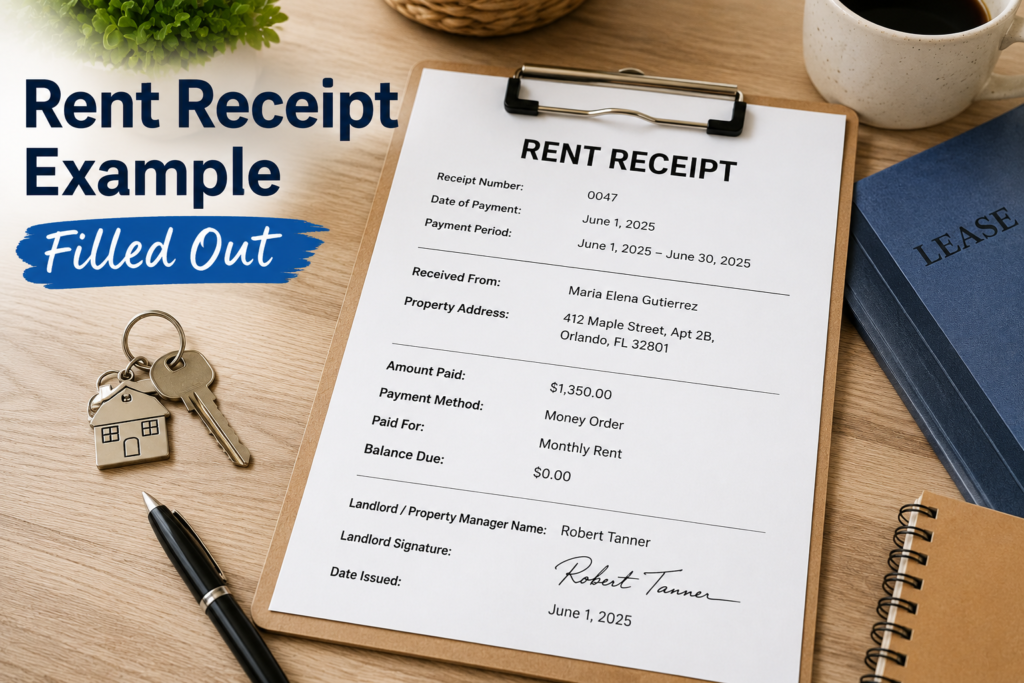
Here’s a sample rent receipt, completed the way it should look in the real world:
RENT RECEIPT
Receipt Number: 0047 Date of Payment: June 1, 2025 Payment Period: June 1, 2025 – June 30, 2025
Received From: Maria Elena Gutierrez Property Address: 412 Maple Street, Apt 2B, Orlando, FL 32801
Amount Paid: $1,350.00 Payment Method: Money Order
Paid For: Monthly Rent
Balance Due: $0.00
Landlord / Property Manager Name: Robert Tanner Landlord Signature: (signed) Date Issued: June 1, 2025
That’s it. No legal jargon. No fancy formatting required. Just clean, accurate documentation of the transaction.
What Each Field Means — Field-by-Field Breakdown
Receipt Number
This is a sequential number you assign to each receipt. Starting at 0001 and going up makes it easy to track payments over time, especially if you manage more than one unit. If a tenant claims they paid and you have no receipt #0047 in your records, that number discrepancy matters in a dispute.
Date of Payment
The actual date the money changed hands — not the due date. If your tenant pays on June 3rd for June rent, write June 3rd. Accuracy here prevents confusion.
Payment Period
This clarifies what the payment covers. For month-to-month leases, this is typically the first to the last day of the month. For partial-month payments, list the exact dates covered.
Received From (Tenant Name)
Write the tenant’s full legal name as it appears on the lease. If two people are on the lease and one drops off a check, still document whose account it covers.
Property Address
Include the full street address plus unit number. This is especially important if you own multiple rental properties — it ties the receipt to a specific unit.
Amount Paid
Write out the exact dollar amount. If a tenant paid $1,200 of a $1,350 balance, write $1,200 — don’t round up. A receipt for a partial payment is still a valid and important document.
Payment Method
Common options: cash, check, money order, Zelle, Venmo, bank transfer, or cashier’s check. This field matters most for cash payments — it’s the only paper trail that money moved.
Paid For
Usually “Monthly Rent,” but could also be “Partial Rent,” “Late Fee,” “Security Deposit,” or “Pet Deposit.” Be specific so there’s no ambiguity about what the payment was for.
Balance Due
If the tenant paid in full, write $0.00. If there’s still an outstanding balance, list it here. This one field can prevent a lot of arguments at month’s end.
Landlord Name and Signature
Your name and signature authenticate the receipt. Without it, the document is just a piece of paper. If you manage properties through an LLC, you can sign as the authorized agent.
Date Issued
Usually the same as the date of payment, but not always. If a tenant drops off a money order on a Friday and you don’t process it until Monday, the issue date might be later. Be consistent with your own system.
Common Mistakes to Avoid
- Leaving the payment method blank — especially for cash. If you don’t document it, there’s no proof the transaction happened.
- Using vague “Paid For” descriptions — “misc payment” creates confusion. Be specific.
- Skipping the signature — an unsigned receipt is harder to defend if challenged.
- Not numbering receipts — sequential numbers are your audit trail.
- Issuing one receipt for multiple months — if a tenant pays two months at once, issue two receipts, one per period.
Cash Payments Deserve Extra Attention
If your tenant pays in cash, a receipt isn’t optional — it’s your only documentation that the payment happened. Several states require landlords to provide written receipts for cash payments by law.
For a complete walkthrough of how to handle cash rent payments and why documentation is so critical, read our post on how to document cash rent payments.
Disclaimer: This post is for informational purposes only and does not constitute legal advice. Landlord-tenant laws vary by state. Consult a licensed attorney or your state housing agency for guidance specific to your situation.
Rent Receipt Books vs. Generating One Online
A lot of small landlords still use paper rent receipt books — the kind you pick up at an office supply store with carbon copies. They work, but they have real drawbacks:
- Hard to store and search later
- Easy to lose
- No digital backup
- Can’t be emailed to a tenant instantly
A free online generator solves all of those problems. You fill in the fields, download a clean PDF, and send it to your tenant in under a minute. No book to carry around, no running out of carbon copies.
Generate your free rent receipt at FreeRentReceipt.com — it takes less than 60 seconds and there’s nothing to sign up for.
Frequently Asked Questions
What should a rent receipt include?
At minimum: the date of payment, tenant’s name, property address, amount paid, payment method, the period covered, and the landlord’s name or signature. Some states may require additional fields — check your state’s landlord-tenant laws or visit HUD.gov for federal housing guidance.
Is a handwritten rent receipt valid?
Yes — a handwritten receipt is legally valid in most states, as long as it includes the required information. Typed or printed receipts are easier to read and harder to dispute, but a signed handwritten note works in a pinch.
Do I have to give a rent receipt for every payment?
It depends on your state. Some states — like California, Maryland, and Washington — require landlords to provide a written receipt for cash payments. Even where it’s not required by law, issuing receipts is a best practice that protects you from payment disputes. See our state-by-state rent receipt laws guide for specifics.
Can I use a rent receipt as proof of income for my tenant?
Yes — tenants often need rent receipts when applying for housing assistance, renewing leases elsewhere, or filing taxes. A well-formatted receipt showing consistent monthly payments serves as a solid paper trail. The IRS also recommends maintaining accurate rental income records; see IRS Publication 527 for guidance on residential rental property.
What’s the difference between a rent receipt and a rent statement?
A rent receipt confirms a payment was received. A rent statement is a running account that shows a history of payments, balances, and charges over time. Most small landlords only need receipts — statements are more common in larger property management contexts.
Ready to create a professional receipt for your next payment? Generate your free rent receipt at FreeRentReceipt.com — it’s free, instant, and requires no account.
