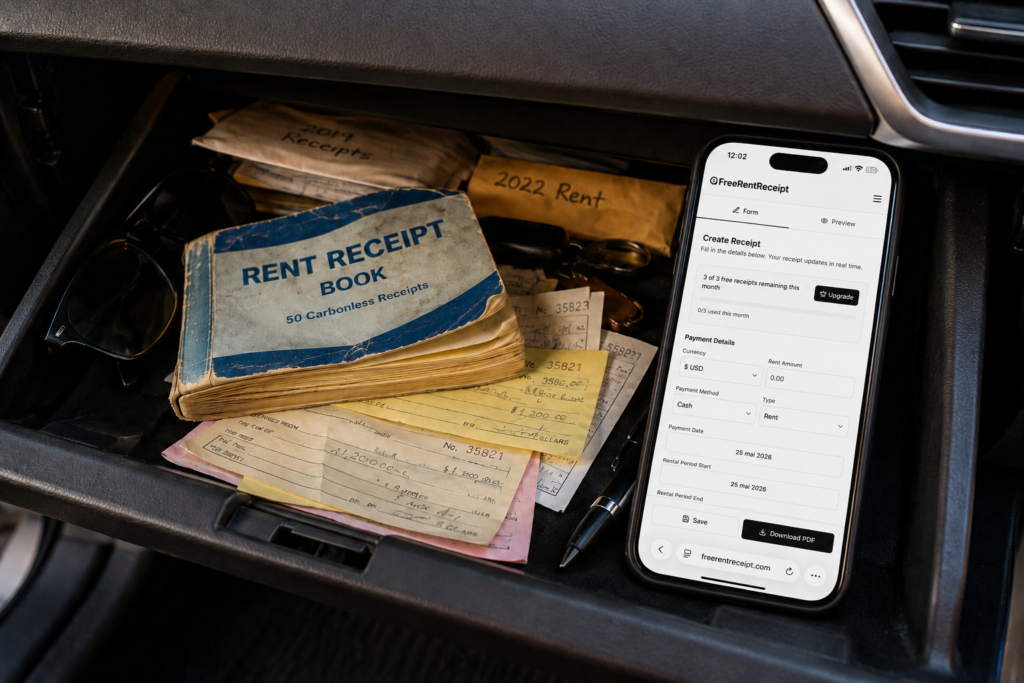
If you’ve ever walked into an office supply store looking for a way to document rent payments, you’ve probably spotted them on the shelf — small carbonless paper booklets labeled “Rent Receipt Book.” They’re cheap, they’re familiar, and a lot of small landlords have been using them for decades.
They work. But they also have some real limitations that add up over time — especially if you’re managing even two or three units and need records that are easy to find, share, and back up.
This post breaks down exactly what a rent receipt book is, how to use one correctly, and when it makes more sense to skip the paper entirely and generate your free rent receipt at FreeRentReceipt.com instead.
What Is a Rent Receipt Book?
A rent receipt book is a pre-printed pad or booklet of paper receipt forms designed specifically for landlords. Each page contains fields for the standard information a rent receipt requires — tenant name, property address, amount paid, payment method, date, and landlord signature.
Most rent receipt books use carbonless copy paper (sometimes called NCR paper — “No Carbon Required”). When you write on the top sheet, the impression transfers to the copy beneath it. You tear out the top copy and give it to the tenant; the copy stays bound in the book as your record.
That built-in duplication is the main appeal. You fill it out once, you both walk away with a copy.
What a Typical Rent Receipt Book Includes
Most standard rent receipt books sold at office supply stores include:
- Pre-numbered receipt forms (usually 50–100 per book)
- Fields for: date, received from, address, amount, payment method, and balance due
- A signature line for the landlord
- A carbonless duplicate that stays in the book
- Sometimes a small ledger section for tracking monthly totals
Brands like Adams, Dome, and Tops are common. Most run between $6 and $15 for a book of 50–100 receipts.
How to Fill Out a Rent Receipt Book
Using a rent receipt book correctly is straightforward, but a few habits make a big difference:
1. Press firmly. Carbonless paper only transfers if you apply consistent pressure. A light touch can leave the copy faint or incomplete — which defeats the purpose.
2. Use a ballpoint pen. Felt-tip and rollerball pens don’t transfer as reliably on NCR paper. Stick with a standard ballpoint.
3. Fill out every field. Don’t skip the payment method or the balance due line. Incomplete receipts are harder to rely on in a dispute.
4. Sign it. An unsigned receipt is just a note. Your signature authenticates the document.
5. Tear out the top copy only. Leave the carbonless duplicate in the book. That book is your running record.
6. Keep the book somewhere safe. A lost or damaged receipt book means lost records. Store it somewhere consistent — not in a car, not loose in a bag.
For a complete step-by-step walkthrough of every field on a rent receipt, see our guide on how to fill out a rent receipt.
The Real Limitations of Paper Receipt Books
A rent receipt book is a perfectly valid tool. But if you’ve used one for any length of time, you’ve probably run into at least a few of these problems:
You Can’t Search It
If a tenant disputes a payment from eight months ago, your only option is flipping through every page of the book by hand. There’s no “find” function, no filter by date, no way to pull up a specific unit quickly.
There’s No Digital Backup
If the book is lost, damaged, soaked, or burned — your records go with it. There’s no cloud copy, no email thread, no backup anywhere.
You Can’t Email It to Your Tenant
A growing number of tenants pay electronically or live remotely from the landlord. Tearing out a paper receipt and mailing it isn’t realistic for everyone. Tenants increasingly expect to receive documentation digitally.
The Book Eventually Runs Out
A 50-receipt book lasts about four months for a single unit. At one receipt per month per unit, two units burns through a book in two years. Then you’re buying another one, trying to store multiple books, and hoping you labeled them clearly.
Carbon Copies Fade
Carbonless paper copies can fade significantly over time — sometimes within a few years. If you need to reference a receipt from three years ago, the copy in your book might be barely legible.
It Doesn’t Scale
Managing one unit? A receipt book is fine. Managing four? You’re juggling multiple books or cramming everything into one and losing track of which unit paid what.
Rent Receipt Book vs. Free Online Generator — Side by Side
| Feature | Paper Receipt Book | FreeRentReceipt.com |
|---|---|---|
| Cost | $6–$15 per book | Free |
| Searchable records | No | Yes (saved PDFs) |
| Digital copy | No | Yes — PDF download |
| Email to tenant instantly | No | Yes |
| Works for multiple units | Cumbersome | Easy |
| Runs out / needs replacing | Yes | Never |
| Fades over time | Yes | No |
| Professional appearance | Basic | Clean, formatted PDF |
| Requires supplies (pen, book) | Yes | No |
When a Rent Receipt Book Still Makes Sense
To be fair — paper receipt books aren’t obsolete for everyone. There are situations where they’re the right call:
- You have one tenant who pays cash in person, and you want to hand them something physical right then and there
- You’re not comfortable with digital tools and prefer paper-based systems
- Your tenants don’t have email and need a physical document
- You’re in an area with unreliable internet access and need an offline solution
If any of those apply to you, a receipt book is perfectly fine. Just be aware of the backup problem — consider photographing each completed receipt with your phone so you have a digital copy in addition to the paper one.
A Better Approach for Most Small Landlords
For most landlords managing one to four units, a free online generator is faster, cleaner, and easier to manage long-term. Here’s what the workflow looks like:
- Tenant pays (cash, money order, Zelle, check — whatever)
- You open FreeRentReceipt.com on your phone or computer
- Fill in the fields (takes about 60 seconds)
- Download the PDF
- Email it to the tenant and save a copy to your records folder
That’s it. No book to carry around, no pen required, no fading copies. And because it’s a PDF, you can organize receipts by tenant and year in a simple folder system that’s easy to search later.
For a full look at how to stay organized across multiple units and multiple months — especially heading into tax season — see our post on how to organize rental income records for tax season.
The IRS expects landlords to maintain accurate records of rental income. IRS Publication 527 covers recordkeeping requirements for residential rental property — and a folder of well-labeled PDFs holds up a lot better than a stack of faded carbon copies.
Generate your free rent receipt at FreeRentReceipt.com — no account, no cost, ready in under 60 seconds.
Disclaimer: This post is for informational purposes only and does not constitute legal advice. Requirements for rent receipts vary by state. Consult a licensed attorney or your state’s housing agency for guidance specific to your situation.
Frequently Asked Questions
What is a rent receipt book used for?
A rent receipt book is used by landlords to document rent payments — typically cash or money order payments — at the time they’re received. Each receipt records the tenant’s name, amount paid, property address, payment date, period covered, and landlord signature. The carbonless duplicate stays in the book as the landlord’s record; the original goes to the tenant.
Where can I buy a rent receipt book?
Rent receipt books are available at office supply stores like Staples and Office Depot, as well as online through Amazon and Walmart. Common brands include Adams, Tops, and Dome. They typically cost between $6 and $15 for a book of 50–100 receipts. Alternatively, you can skip the paper entirely and use a free online generator like FreeRentReceipt.com.
How many receipts are in a standard rent receipt book?
Most standard rent receipt books contain 50 to 100 pre-numbered receipt forms. At one receipt per month per unit, a 50-receipt book covers about four years for a single tenant. If you manage multiple units, you’ll go through books faster.
Is a rent receipt book legally required?
No — there’s no law requiring landlords to use a receipt book specifically. What matters is that you provide a written receipt when required by your state. Many states require written receipts for cash payments in particular. See Nolo’s overview of landlord-tenant law for plain-English guidance by state, or check HUD.gov for federal housing resources.
Can I use a digital receipt instead of a paper receipt book?
Yes — a digital receipt is just as valid as a paper one in most jurisdictions, as long as it includes the required information and is signed (electronically or with a printed signature). A PDF generated from an online tool is easier to store, search, and share than a paper carbon copy, and it doesn’t fade over time.
Done with the receipt book? Generate your free rent receipt at FreeRentReceipt.com — it’s free, instant, and works on your phone.
