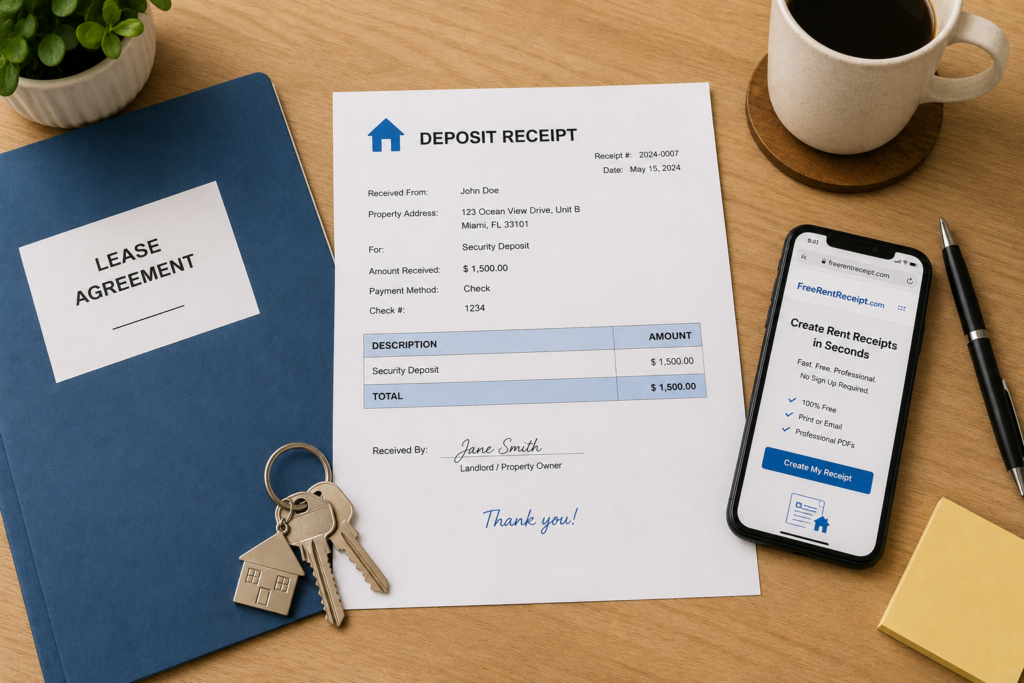
Collecting a security deposit at move-in is standard practice. Writing it down properly — not so standard. A lot of small landlords hand over the keys, collect the first month plus deposit, and never give the tenant any written confirmation. That’s a problem.
If a dispute comes up later — and it often does — a missing receipt can cost you in court. Several states actually require landlords to provide written documentation when a security deposit is collected. Even where it’s not legally required, having a paper trail protects you.
This post covers what a rent deposit receipt is, how it’s different from a regular rent receipt, what it needs to include, and how to generate one for free in under two minutes.
What Is a Rent Deposit Receipt?
A rent deposit receipt is a written acknowledgment that you, the landlord, received a security deposit from your tenant. It documents the amount collected, the date, and the purpose of the funds — so both parties are clear on what was paid and what it’s for.
It’s not the same as a lease agreement, and it’s not the same as a rent receipt.
- A lease agreement defines the terms of the tenancy.
- A rent receipt confirms a monthly rent payment was received.
- A rent deposit receipt (or security deposit receipt) confirms the upfront deposit was received — separately from rent.
Some landlords combine the first month’s rent and security deposit into a single receipt. That’s fine as long as each amount is itemized clearly. When they’re lumped together with no breakdown, you’re asking for trouble if the tenant disputes what they paid.
Why It Matters Legally
Several states have specific rules about security deposits — including requirements to provide written receipts, place deposits in a separate bank account, and return them within a set number of days after move-out.
Here’s a quick look at three high-traffic states:
Florida: Landlords must inform tenants in writing about where the deposit is being held (bank name, address, and account type or surety bond details). This must be done within 30 days of receiving the deposit. Failure to comply can cost you the right to make deductions. See Florida Statutes §83.49 for the full requirements.
California: Landlords must provide a receipt for any deposit paid in cash. Security deposits are capped at one month’s rent for unfurnished units. See California Civil Code §1950.5 for details.
Texas: Texas law doesn’t mandate a written receipt at the time of collection, but landlords are required to return the deposit (with an itemized deduction list if applicable) within 30 days of move-out. See Texas Property Code §92.103.
For a broader overview of deposit rules by state, check out our post on state-by-state rent receipt laws for landlords.
Disclaimer: This post is for informational purposes only and is not legal advice. Laws vary by state and locality. Consult a licensed attorney or your state’s housing authority for guidance specific to your situation.
What to Include on a Rent Deposit Receipt
Whether you’re using a template or drafting one from scratch, every rent deposit receipt should include the following:
1. Tenant Name(s) List all tenants named in the lease. This prevents disputes about who paid what.
2. Property Address Full address of the rental unit. If you manage multiple units, this keeps records clean.
3. Date the Deposit Was Received The exact date matters — especially in states with strict timelines for deposit handling.
4. Amount Received Break down the amounts clearly. If you collected first month’s rent and a security deposit together, list them as separate line items.
5. Purpose of the Payment Label it clearly: “Security Deposit.” If it’s also covering last month’s rent or a pet deposit, note that separately.
6. Payment Method Cash, check, Venmo, bank transfer — note how it was paid. This is especially important for cash payments.
7. Landlord Name and Signature Your signature makes it official. Even a typed name is better than nothing.
8. Running Balance (if applicable) If any amount is still owed, note the balance due.
Rent Receipt vs. Deposit Receipt: Don’t Mix Them Up
This is a common mistake. A landlord collects the first month’s rent and security deposit at the same time, then issues a single receipt with a total. The tenant moves out two years later and claims they overpaid their deposit. You can’t prove otherwise because the original receipt didn’t break it down.
Keep these as separate documents — or at minimum, itemized line items on the same receipt. It takes 30 extra seconds and saves hours of headache.
For a deeper look at how rent receipts and lease agreements work together, see our post on rent receipt vs. lease agreement: what’s the difference.
Using a Rent and Deposit Receipt Template
You don’t need a lawyer or a property management platform to create a proper receipt. What you need is a consistent format you use every time — so every tenant gets the same documentation, and your records stay organized.
The fastest way to do this: generate your free rent receipt at FreeRentReceipt.com. The tool lets you fill in the tenant name, property address, payment amounts, and payment method — then generate a clean, printable PDF receipt in seconds. You can use it for monthly rent receipts and one-time deposit receipts.
It’s free, no account required, and works on any device.
Keeping Your Deposit Records Organized
Once you issue a deposit receipt, file it somewhere you’ll find it again. Here’s a simple system that works even if you manage just one or two units:
- Create a folder per tenant (physical or digital).
- Store the original lease, the deposit receipt, and a move-in inspection checklist together.
- When the tenant moves out, pull the folder and compare deposit amount vs. deductions.
This takes 10 minutes to set up and protects you from almost every common landlord-tenant dispute.
For more on keeping your rental income records in order, see our guide on how to organize rental income records for tax season.
The IRS also provides guidance on what rental income and expense records landlords should retain — see IRS Publication 527: Residential Rental Property for details.
Generate Your Free Deposit Receipt Now
You’ve already done the hard part — screening the tenant, signing the lease, handing over the keys. Don’t skip the paper trail on the deposit.
Generate your free rent and deposit receipt at FreeRentReceipt.com — no account, no signup, no cost. Fill in the fields, hit generate, and you’re done.
FAQ: Rent Deposit Receipt
Q: Is a security deposit receipt legally required? It depends on your state. Florida, California, and several other states require landlords to provide written documentation when a security deposit is collected. Even where it’s not required by law, issuing a receipt is always a good idea — it protects both parties. Check HUD’s tenant rights resources or your state’s landlord-tenant statute for specifics.
Q: What’s the difference between a rent receipt and a security deposit receipt? A rent receipt documents a monthly rent payment. A security deposit receipt documents the upfront deposit collected at the start of the tenancy. They serve different purposes and should be kept as separate records. See our post on how a rent receipt differs from a lease agreement for more context.
Q: Can I use one receipt for both first month’s rent and the security deposit? Yes, but each amount must be itemized separately. Don’t list a lump sum — break it down by line item so it’s clear how much was paid for rent vs. the deposit.
Q: What happens if I don’t provide a security deposit receipt in a state that requires one? Consequences vary by state, but they can include losing the right to make deductions from the deposit, being required to return the full deposit regardless of damages, or even paying the tenant penalties. In Florida, failure to comply with deposit rules can void your claim entirely. See Nolo’s guide on security deposit rules by state for a plain-English breakdown.
Q: How long should I keep security deposit receipts? Keep them for at least as long as the tenancy lasts, plus any applicable statute of limitations in your state for small claims disputes — typically 2 to 5 years after move-out. Storing them digitally (as PDFs) is the easiest long-term solution.
