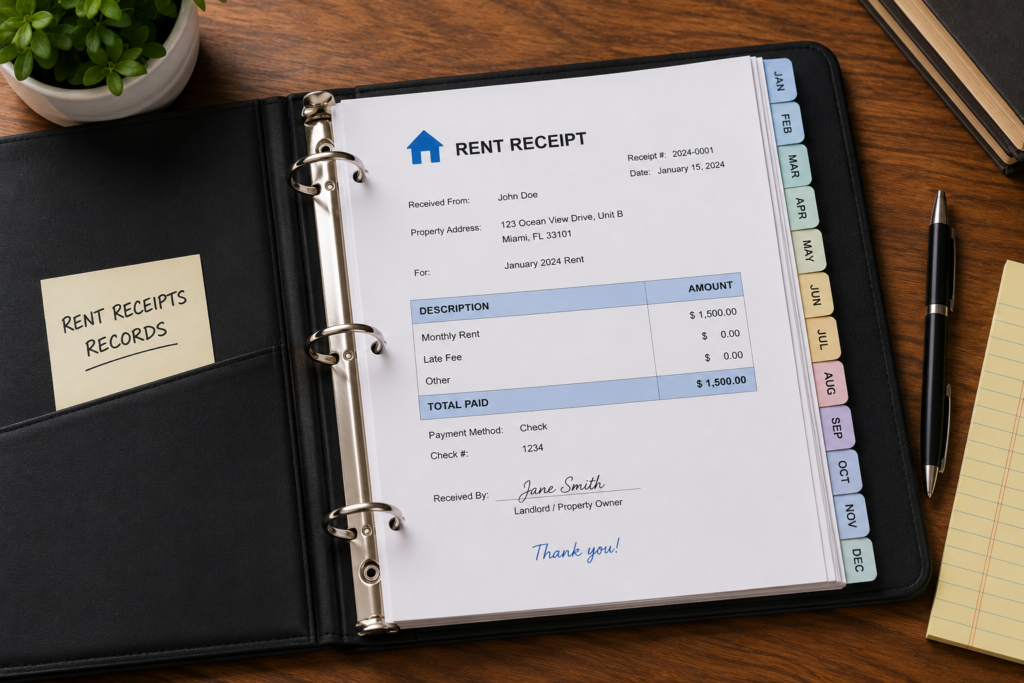
A tenant pays. You collect. Simple enough — until there’s a dispute over whether that payment ever happened.
A receipt of rent payment is your paper trail. It’s the one document that proves a specific transaction took place: who paid, how much, when, and for what property. Without it, a late fee argument or an eviction hearing can turn into your word against theirs.
This post covers why a rent paid receipt matters more than most landlords realize, what it needs to include to hold up as actual documentation, and how you can generate one for free in about 60 seconds.
What Is a Receipt of Rent Payment?
A receipt of rent payment is a written record that confirms a tenant made a rent payment. It documents the completed transaction — not the lease, not the payment method, but the fact that money changed hands on a specific date for a specific amount.
Think of it like a receipt you get from a store. You bought something, paid for it, and got proof. A rent paid receipt works the same way.
It’s different from your lease agreement. The lease says what the tenant owes. The receipt proves they paid. These are two separate documents that serve two very different purposes. (More on that distinction: Rent Receipt vs. Lease Agreement: What’s the Difference?)
Why a Receipt of Rent Payment Receipts Matter More Than You Think
Legal Protection in Disputes
If a tenant claims they paid and you claim they didn’t, the receipt is the deciding document. In eviction proceedings, judges expect documentation. A clear, dated receipt — or the absence of one — can determine the outcome.
Many states actually require landlords to provide a receipt for rent payment when a tenant pays in cash. Some require it in writing on request regardless of payment method. Check your state’s rules — you can find a state-by-state breakdown at State-by-State Rent Receipt Laws for Landlords.
Tax Records and Rental Income Tracking
At tax time, the IRS expects you to report all rental income accurately. Rent payment receipts are part of the documentation trail that supports your Schedule E filings. If you’re audited, having a consistent record of receipts for every rent payment — matched against your reported income — is the difference between a clean audit and a problem one. The IRS guidance on rental income and expenses makes clear that good records are your first line of defense.
For a deeper look at staying organized through tax season, see How to Organize Rental Income Records for Tax Season.
Tenant Protection Too
Tenants benefit just as much as landlords. A receipt of rent payment is their proof that they’re current — useful when applying for a new rental, dealing with a dispute, or simply keeping their own financial records. When you issue receipts consistently, tenants tend to be more organized and less likely to claim confusion about what’s owed.
What a Rent Paid Receipt Must Include to Be Useful
A receipt for rent payment is only as good as the information it contains. A vague note that says “rent paid” isn’t going to help you in a dispute. Here’s what every receipt needs:
1. Tenant’s Full Name The person who made the payment, not just the unit number.
2. Rental Property Address Including unit number if applicable. If you manage more than one property, this is especially important.
3. Payment Date The exact date the payment was received — not the due date, the actual receipt date.
4. Amount Paid Written out clearly in numbers (and optionally in words to avoid any ambiguity).
5. Payment Method Cash, check, money order, bank transfer, or app payment. If it was a check, note the check number.
6. Rental Period Covered Which month (or period) the payment is being applied to. “June 2025 rent” is clearer than just a date.
7. Landlord Name and Signature Or your property management company name. This is what makes the receipt official.
8. Receipt Number (recommended) Makes filing, sorting, and referencing much easier over time.
An optional but useful addition: a running balance notation if the tenant carries a balance or prepaid.
When to Issue a Receipt for Rent Payment
The short answer: always.
Best practice is to issue a receipt every single time rent is collected, regardless of payment method. Yes, even if you collect by Venmo or Zelle — those apps show the transaction, but a formal receipt of rent payment documents the purpose and period covered in a way that an app notification doesn’t.
Some landlords wait until a tenant asks. Don’t do this. Issuing receipts proactively protects you and builds trust with your tenants.
Best practice:
- Issue the receipt within 24–48 hours of receiving payment
- Email a digital copy and/or hand over a printed copy
- Keep a copy for your own records organized by tenant and month
Digital vs. Paper: Which Format Is Better?
Both work. What matters is that the receipt is legible, complete, and kept somewhere you can find it later.
Paper receipts work fine, but they get lost, fade, or aren’t ready when you need them. Handwritten receipt books are a step up, but they’re still prone to errors and hard to search.
Digital receipts are faster to generate, easy to store, and simple to email to your tenant on the spot. They also look more professional, which helps with tenant relationships.
The easiest approach is to use a free online tool — no downloads, no templates to format, no worrying about whether you included every field. You fill in the details, the tool generates a clean, printable receipt, and you’re done.
Generate your free rent receipt at FreeRentReceipt.com — it takes about a minute, and you can download or email the receipt immediately.
Common Mistakes Landlords Make with Rent Receipts
Not issuing them consistently. One month you do, three months you don’t — now your records have gaps that look suspicious.
Missing the payment period. “Paid $1,200” tells you nothing. “$1,200 for July 2025 rent at 412 Oak St, Unit 3” is a record.
Confusing receipt date with due date. The receipt date is when you actually received the money. If rent was due the 1st and the tenant paid on the 5th, the receipt date is the 5th. That distinction matters if you ever charge late fees.
Losing the paper trail. Keep receipts organized by tenant and date — whether in a folder, a cloud drive, or a dedicated property management system.
Create a Receipt for Rent Payment Right Now
You don’t need a template, a Word document, or a printer on standby. FreeRentReceipt.com lets you fill in your tenant’s details, property info, and payment amount — and generates a clean, downloadable rent payment receipt instantly.
Generate your free rent receipt at FreeRentReceipt.com — free, no sign-up required.
If you want to understand the full format in more detail before creating one, How to Write a Rent Receipt: Complete Guide for Landlords walks you through every field.
FAQ
What is a receipt of rent payment?
A receipt of rent payment is a written document that confirms a tenant paid rent. It records the amount, payment date, rental period covered, tenant name, property address, and payment method. It serves as proof that a specific transaction occurred.
Is a landlord required to give a rent receipt?
It depends on your state. Several states require landlords to provide a written receipt when rent is paid in cash — and some require it on request regardless of payment method. Even where it’s not legally required, issuing receipts is strongly recommended as a standard practice. See the full breakdown at State-by-State Rent Receipt Laws for Landlords.
Can a rent receipt be used as proof of payment in court?
Yes. A properly completed rent paid receipt — with the tenant’s name, property address, amount, date, and landlord signature — can be used as documentation in eviction proceedings, small claims disputes, or any situation where proof of payment is needed. For this reason, it’s important that every receipt is complete and accurate.
What’s the difference between a rent receipt and a lease agreement?
A lease agreement states what a tenant owes and under what conditions. A receipt for rent payment proves that a specific payment was made. One is a contract; the other is a transaction record. You need both, but they serve completely different purposes.
How long should I keep rent payment receipts?
Most tax and legal advisors recommend keeping rental income records — including rent receipts — for at least three to seven years. The IRS generally has three years from your filing date to audit a return, but that window extends to six years if significant income was underreported. Keep them organized and accessible. See the IRS recordkeeping guidance and HUD’s tenant record resources for additional context.
Disclaimer: This post is for general informational purposes only and does not constitute legal advice. Landlord-tenant laws vary by state and locality. Consult a licensed attorney or your local housing authority for advice specific to your situation.
