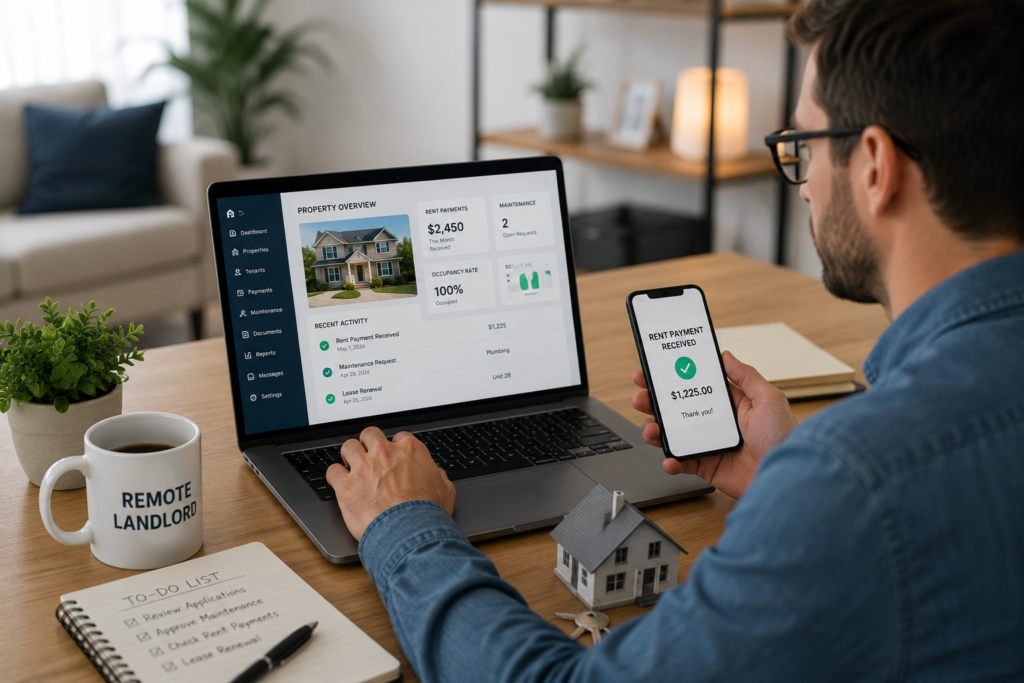
You don’t live near your rental. Maybe you moved for a job, inherited the property, or bought it as an investment three states away. Either way, the basics of landlording — showing up for repairs, handing tenants a receipt, walking the unit before an inspection — get a lot harder when “stopping by” means a plane ticket, you need to know how to manage rental property remotely.
The good news is that distance isn’t a dealbreaker. Thousands of landlords run profitable, low-drama rentals they’ve never set foot in for months at a time. The difference between a remote landlord who sleeps fine and one who’s constantly putting out fires is usually one thing: systems. Documentation, communication, and a short list of trusted people on the ground.
This guide covers how to build those systems, including the extra paperwork that comes with Section 8 units, so you can manage your property from anywhere without losing track of who paid what, who inspected what, and when.
This article is for informational purposes only and does not constitute legal or tax advice. Laws vary by state. Consult a qualified attorney or tax professional for advice specific to your situation.
Build Your Remote Management Systems
When you’re not on-site, every informal habit you used to rely on — a quick conversation in the hallway, a handshake over a cash payment — needs to become something written down and trackable. That’s not extra bureaucracy for its own sake; it’s what protects you when a question comes up six months later and you weren’t there to remember the answer.
Digital Rent Collection and Documentation
Cash and paper checks are the hardest payment methods to manage remotely, simply because someone has to physically handle them. If you can move tenants toward an online rent payment system, you get an automatic record of when rent arrived and how much.
But payment history alone isn’t the same as a receipt. Tenants, especially ones who pay by money order or in person to a property manager, often still expect a proper rent receipt for their own records, particularly if they’re applying for assistance programs or need proof of payment for a loan application. Instead of mailing a paper receipt from out of state, generate your free rent receipt at FreeRentReceipt.com the moment payment clears — it takes under a minute and gives both you and the tenant a clean digital record with no printer required.
Communication Protocols With Tenants
Distance amplifies small communication gaps into big ones. Set expectations early: how tenants should report maintenance issues, your standard response time, and who to call for true emergencies versus routine fixes. Putting this in writing — in the lease and again in a welcome email — saves you from being blindsided by a 2 a.m. text about a leaky faucet.
A simple system works best: one channel for non-urgent requests (email or a property app), one number for emergencies, and a local contact (handyman, co-landlord, or property manager) who can physically respond when you can’t. For tips on keeping all of this organized, our guide to landlord record-keeping covers what to track and for how long.
How to Manage Rental Property Remotely: Handling Property Inspections From a Distance
Inspections are where remote landlording gets genuinely tricky, because you can’t always be the one walking the unit. You have two real options: hire local help, or coordinate inspections yourself using video and a trusted point of contact.
Hiring a Local Inspector or Property Manager
For routine move-in and move-out inspections, a local property manager, real estate agent, or independent inspector can walk the unit, take photos, and complete a condition report on your behalf. This costs money, but for landlords managing property in another state, it’s often worth it — especially for inspections tied to a government program, where a missed deadline can delay your rent payments. Nolo’s guide on when to hire a property management company breaks down the situations, including out-of-state ownership, where outside help typically pays for itself.
If you’d rather handle it yourself, a video call with the tenant or a trusted local contact, paired with timestamped photos, can substitute for an in-person inspection in many situations — though check your state’s specific notice and entry requirements before relying on this approach.
Section 8 Inspection Checklist
If any of your units are part of the Housing Choice Voucher program, inspections aren’t optional walkthroughs — they’re a federal requirement tied directly to whether you get paid. Understanding what inspectors look for, and prepping ahead of time, matters even more when you can’t be there in person.
Section 8 inspection requirements and Public Housing Authority procedures vary by location. This section provides general information only — confirm current requirements with your local PHA before scheduling an inspection.
What HQS Inspections Cover
Housing Quality Standards (HQS) inspections check that a unit is safe, decent, and sanitary before a voucher holder moves in, and again on a recurring basis afterward. Inspectors typically check working smoke and carbon monoxide detectors, secure and intact windows and screens, functioning heating and plumbing systems, and any visible safety hazards like exposed wiring or peeling paint. HUD’s landlord resources for the Housing Choice Voucher program outline the program’s standards and what’s expected of owners in more detail.
Prepping a Unit Remotely Before Inspection Day
Since you likely won’t be on-site, lean on whoever is — a tenant, property manager, or maintenance contact — to walk through a basic pre-inspection checklist a few days ahead: test every smoke detector, confirm all light fixtures and outlets work, check that windows open and close properly, and clear any obvious safety hazards. A failed inspection doesn’t just mean a repair list; it can pause your housing assistance payments until the unit is corrected and re-inspected, which is a costly delay to manage from a distance.
How to Become a Section 8 Landlord
If you’re considering adding a voucher tenant to your remote rental, the process runs through your local Public Housing Authority (PHA), not HUD directly.
Enrollment Steps With Your Local PHA
Generally, you’ll contact the PHA in the unit’s jurisdiction, confirm the unit meets local rent reasonableness standards, and schedule the required HQS inspection before a Housing Assistance Payments (HAP) contract is signed. Every PHA runs its own intake process and paperwork set, so confirm specifics locally before assuming the steps are identical everywhere.
What Changes About Rent Collection and Documentation Once Enrolled
Once enrolled, part of the rent (the housing assistance payment) comes from the PHA, and the tenant pays the remaining portion directly to you. That split payment makes documentation even more important: you’ll want a clear, dated rent receipt for the tenant-paid portion specifically, separate from the subsidy payment, so your records line up cleanly if the PHA or tenant ever needs proof of what was paid and when. Document every payment in seconds — try the free receipt generator at FreeRentReceipt.com for the tenant-paid portion of any voucher arrangement.
You don’t live near your rental. Maybe you moved for a job, inherited the property, or bought it as an investment three states away. Either way, the basics of landlording — showing up for repairs, handing tenants a receipt, walking the unit before an inspection — get a lot harder when “stopping by” means a plane ticket.
The good news is that distance isn’t a dealbreaker. Thousands of landlords run profitable, low-drama rentals they’ve never set foot in for months at a time. The difference between a remote landlord who sleeps fine and one who’s constantly putting out fires is usually one thing: systems. Documentation, communication, and a short list of trusted people on the ground.
This guide covers how to manage rental property remotely, including the extra paperwork that comes with Section 8 units, so you can stay on top of your rental from anywhere without losing track of who paid what, who inspected what, and when.
This article is for informational purposes only and does not constitute legal or tax advice. Laws vary by state. Consult a qualified attorney or tax professional for advice specific to your situation.
Build Your Remote Management Systems
When you’re not on-site, every informal habit you used to rely on — a quick conversation in the hallway, a handshake over a cash payment — needs to become something written down and trackable. That’s the core of learning to manage rental property remotely: it’s not extra bureaucracy for its own sake, it’s what protects you when a question comes up six months later and you weren’t there to remember the answer.
Digital Rent Collection and Documentation
Cash and paper checks are the hardest payment methods to manage remotely, simply because someone has to physically handle them. For landlords trying to manage rental property remotely, moving tenants toward an online rent payment system is one of the highest-leverage changes you can make — it gets you an automatic record of when rent arrived and how much.
But payment history alone isn’t the same as a receipt. Tenants, especially ones who pay by money order or in person to a property manager, often still expect a proper rent receipt for their own records, particularly if they’re applying for assistance programs or need proof of payment for a loan application. Instead of mailing a paper receipt from out of state, generate your free rent receipt at FreeRentReceipt.com the moment payment clears — it takes under a minute and gives both you and the tenant a clean digital record with no printer required.
Communication Protocols With Tenants
Distance amplifies small communication gaps into big ones. Set expectations early: how tenants should report maintenance issues, your standard response time, and who to call for true emergencies versus routine fixes. Putting this in writing — in the lease and again in a welcome email — saves you from being blindsided by a 2 a.m. text about a leaky faucet.
A simple system works best: one channel for non-urgent requests (email or a property app), one number for emergencies, and a local contact who can physically respond when you can’t. For tips on keeping all of this organized, our guide to landlord record-keeping covers what to track and for how long.
Handling Property Inspections From a Distance
Inspections are where it gets genuinely tricky to manage rental property remotely, because you can’t always be the one walking the unit. You have two real options: hire local help, or coordinate inspections yourself using video and a trusted point of contact.
Hiring a Local Inspector or Property Manager
For routine move-in and move-out inspections, a local property manager, real estate agent, or independent inspector can walk the unit, take photos, and complete a condition report on your behalf. This costs money, but for landlords managing property in another state, it’s often worth it — especially for inspections tied to a government program, where a missed deadline can delay your rent payments. Nolo’s guide on when to hire a property management company breaks down the situations, including out-of-state ownership, where outside help typically pays for itself.
If you’d rather handle it yourself, a video call with the tenant or a trusted local contact, paired with timestamped photos, can substitute for an in-person inspection in many situations — though check your state’s specific notice and entry requirements before relying on this approach.
Section 8 Inspection Checklist
If any of your units are part of the Housing Choice Voucher program, inspections aren’t optional walkthroughs — they’re a federal requirement tied directly to whether you get paid. Understanding what inspectors look for, and prepping ahead of time, matters even more when you’re trying to manage a Section 8 rental property remotely and can’t be there in person.
Section 8 inspection requirements and Public Housing Authority procedures vary by location. This section provides general information only — confirm current requirements with your local PHA before scheduling an inspection.
What HQS Inspections Cover
Housing Quality Standards (HQS) inspections check that a unit is safe, decent, and sanitary before a voucher holder moves in, and again on a recurring basis afterward. Inspectors typically check working smoke and carbon monoxide detectors, intact windows and screens, functioning heating and plumbing, and any visible hazards like exposed wiring or peeling paint. HUD’s landlord resources for the Housing Choice Voucher program outline the program’s standards in more detail.
Prepping a Unit Remotely Before Inspection Day
Since you likely won’t be on-site, lean on whoever is — a tenant, property manager, or maintenance contact — to walk through a basic pre-inspection checklist a few days ahead: test every smoke detector, confirm light fixtures and outlets work, check that windows open and close properly, and clear any obvious safety hazards. A failed inspection doesn’t just mean a repair list; it can pause your housing assistance payments until the unit is corrected and re-inspected — a costly delay to manage from a distance.
How to Become a Section 8 Landlord
If you’re considering adding a voucher tenant, the process runs through your local Public Housing Authority (PHA), not HUD directly.
Enrollment Steps With Your Local PHA
Generally, you’ll contact the PHA in the unit’s jurisdiction, confirm the unit meets local rent reasonableness standards, and schedule the required HQS inspection before a Housing Assistance Payments (HAP) contract is signed. Every PHA runs its own intake process and paperwork set, so confirm specifics locally before assuming the steps are identical everywhere.
What Changes About Rent Collection and Documentation Once Enrolled
Once enrolled, part of the rent (the housing assistance payment) comes from the PHA, and the tenant pays the remaining portion directly to you. That split payment makes documentation even more important: you’ll want a clear, dated rent receipt for the tenant-paid portion specifically, separate from the subsidy payment, so your records line up cleanly if the PHA or tenant ever needs proof of what was paid and when. Document every payment in seconds — try the free receipt generator at FreeRentReceipt.com for the tenant-paid portion of any voucher arrangement.
Managing Rental Property Out of State: Legal & Tax Considerations
Owning across state lines adds a layer most landlords don’t think about until it bites them. Landlord-tenant law is set at the state and sometimes city level, so the rules in the property’s state apply — not the rules where you personally live. If your rental is in Florida, our roundup of Florida landlord-tenant law updates is a useful starting point. Some states also require an out-of-state owner to use an in-state registered agent or licensed property manager for certain functions, so check before assuming you can handle everything yourself from afar.
On the tax side, rental income generally still needs to be reported, and depending on where the property sits versus where you live, you may have state filing obligations in more than one state. The IRS’s guidance on reporting rental income and expenses is a reasonable starting point, but a tax professional familiar with multi-state rental ownership is worth the consultation fee here.
Tools That Make Remote Management Easier
You don’t need an expensive enterprise platform to manage rental property remotely for one to four units — you mostly need a handful of tools that keep records consistent and accessible from anywhere. Property management software can centralize maintenance requests and lease documents; a digital payment system reduces the chance of “the check is in the mail” disputes; and automated rent reminders cut down on late payments before they become a problem.
Documentation is the piece that ties it all together. Our guide to small landlord property management software walks through options scaled for self-managing owners, and our breakdown of cash vs. digital rent payments can help you decide which collection method fits. The simplest habit you can build, regardless of which tools you choose, is generating a receipt every time rent comes in.
For more rental management advice, browse our Landlord Tips category. For receipt templates, documentation help, and proof-of-payment guidance, explore our Rent Receipts category.
Learning to manage rental property remotely comes down to replacing your physical presence with good systems: clear communication, reliable local help for the things you truly can’t do remotely, and airtight documentation for everything else. Get the paperwork habit locked in first — generate a free rent receipt online at FreeRentReceipt.com for every payment — and the rest of remote landlording gets a lot less stressful.
FAQ
Can I manage a rental property without living nearby? Yes. Many landlords successfully manage rental property remotely using digital payment systems, written communication protocols, and a trusted local contact for hands-on tasks like inspections and repairs.
What does a Section 8 inspector look for? Inspectors check that the unit meets Housing Quality Standards: working smoke and carbon monoxide detectors, safe electrical and plumbing systems, intact windows, and no major safety hazards. Requirements can vary slightly by PHA.
How long does it take to become a Section 8 landlord? Timelines vary by local PHA, but the process typically involves an application, a rent reasonableness check, and a scheduled HQS inspection before a Housing Assistance Payments contract is finalized.
Do I need a local property manager for an out-of-state rental? Not always, but it’s common. Some states have specific requirements for out-of-state owners, and having someone local can be essential for inspections, repairs, and emergencies.
How often are Section 8 inspections required? Most units are inspected before move-in and then on a recurring basis afterward, often annually, though exact timing depends on your local PHA’s procedures.
What happens if a Section 8 unit fails inspection? The PHA typically issues a list of required repairs with a deadline. Housing assistance payments can be paused until the unit passes a follow-up inspection.
What software helps landlords manage rentals remotely? Options range from simple digital rent receipt tools to full property management platforms with maintenance tracking, online payments, and tenant communication built in.
